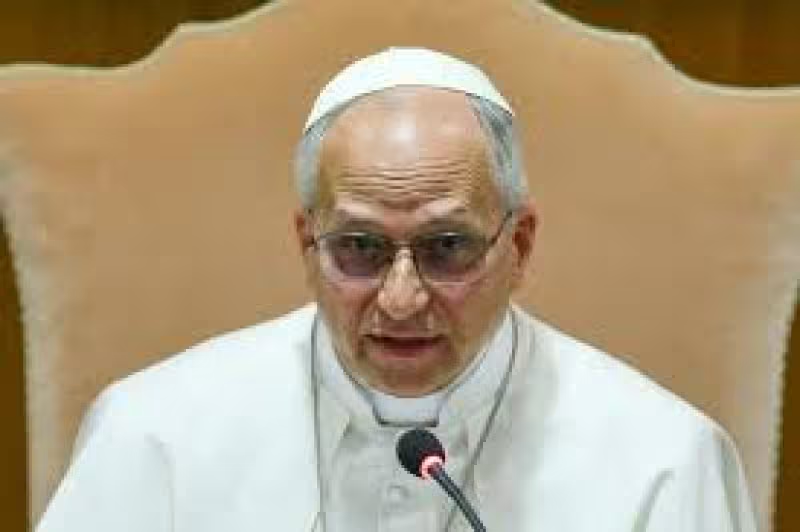
Pope Leo is set to visit Uruguay in November, Teledoce reported Thursday, May 21, citing the Catholic Church in Montevideo, and Uruguay’s foreign ministry said it is preparing for the trip.
The visit would be part of a broader tour of southern Latin America announced in February and is expected to also include Peru and Argentina. Officials and church leaders have said the pope’s trip at the end of the year is expected to draw large crowds across the region.
The planning notice on Thursday landed in a country that has long kept a clear formal distance between church and state. Uruguay is one of the region’s most secular countries, and its institutions are built on a formal separation between religion and government—a fact that will shape how authorities handle security, routing and public events for a papal visit.
Leo’s personal history deepens the stakes. He spent decades as a missionary in Peru, was first ordained a bishop for the diocese of Chiclayo in Peru’s northwest and became a Peruvian citizen in 2015. The tour announced in February, which lists Peru and Argentina alongside Uruguay, will bring that personal backstory into a diplomatic and logistical exercise for three very different countries.
Teledoce’s Thursday report cited the Catholic Church in Montevideo; the same day Uruguay’s foreign ministry confirmed it was preparing for the visit. The announcement is slim on detail: no precise route, no schedule beyond the month, and no public program has been released. That paucity of information is the immediate operational challenge for governments and the church alike as they move from announcement to execution.
The deeper tension is political and cultural. A papal visit that is expected to draw large crowds could unsettle Uruguay’s secular customs simply by the scale of public response. Organizers will have to balance the pastoral aims of the Catholic Church with the protocols of a state that, by design, keeps religious and civic roles separate. For Leo, who has strong ties to Peru through his decades of missionary work and his earlier ordination in Chiclayo, the trip will also be a return to a region where personal history and public ritual intersect.
The next steps are practical and immediate: foreign ministry teams in Montevideo will move from notification to logistics, and the Catholic Church in Uruguay will begin to map venues and programs for a November visit. The most consequential unanswered question is whether a papal pilgrimage of this scale will change how Uruguay navigates the relationship between religion and public life—once the crowds arrive, the country’s long-standing formal separation will be tested by the force of a global religious event.
For readers tracking the regional sweep of the trip, the itinerary’s inclusion of Argentina ties back to broader cultural and diplomatic threads across southern Latin America; for a cultural snapshot, see our piece on culinary crossovers, Next Level Chef: Darian’s Argentina–Germany fusion wins World Cup‑themed challenge —