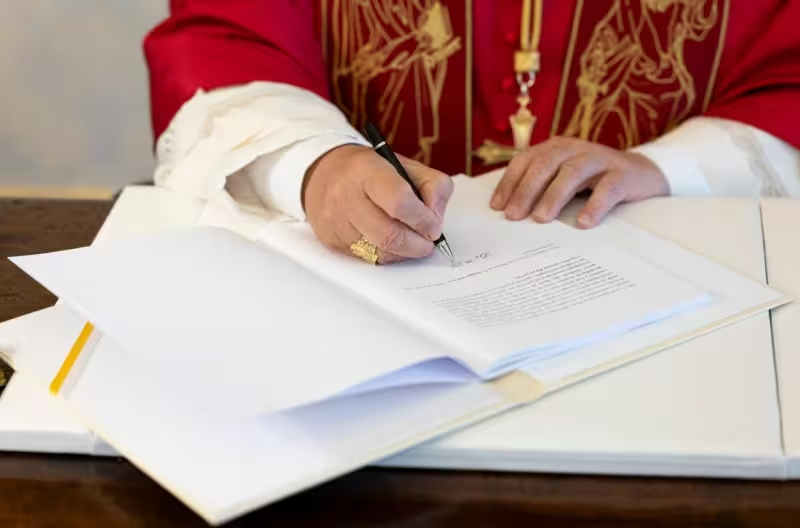
Pope Leo XIV published his first encyclical, Magnifica humanitas: On Safeguarding the Human Person in the Time of Artificial Intelligence, on Monday, May 25, laying out a moral framework for technology and a plea to "remain human."
Signed on May 15 — the 135th anniversary of Pope Leo XIII’s Rerum novarum — the text runs across five chapters and delivers an unmistakable central image: "Humanity, created by God in all its grandeur, is today facing a pivotal choice: either to construct a new Tower of Babel or to build the city in which God and humanity dwell together," the pope writes.
The encyclical explicitly treats artificial intelligence as a question for the Church’s social teaching rather than a purely technical matter. It says technology is not "a force antagonistic to humanity" and is not "inherently evil," while also warning that "technology is never neutral, because it takes on the characteristics of those who devise, finance, regulate, and use it." Pope Leo XIV appeals for people to build "for the common good" and to "remain human," language that stitches theological claims to practical demands.
The document’s first chapter, titled "A Dynamic Approach Faithful to the Gospel," traces the Social Doctrine of the Church through recent magisterium and the Second Vatican Council and describes that teaching as "a theology of communion in history." The encyclical recalls the writings of popes from Pius XII to Pope Francis and describes Pope Leo XIII’s 1891 Rerum novarum as "constitutes a milestone in the development of the Church’s social teaching." The second chapter sets out the "Foundations and Principles of the Social Doctrine of the Church," grounding its approach in the claim that the dignity of the person is created in the image and likeness of God.
Weight in the text comes from clear doctrinal limits as well as endorsements. The encyclical names the first human right as the right to life "from conception to its natural end" and defines induced abortion, the killing of the innocent, and euthanasia as "choices that the Church considers gravely wrong." It also enshrines the principle that "the fundamental dignity of each person…is neither acquired nor earned, nor does it need to be justified." At the same time the pope urges attention to minorities, singling out the recognition of the rights of minorities and "particular attention to women," and calling for "concrete decisions" in favor of women in laws, employment, education, and social life.
Contextually, Magnifica humanitas is presented as a social encyclical and a direct entry of the Catholic social tradition into debates about artificial intelligence. The Vatican reported the publication on Monday, May 25. The text links that contemporary concern to a historical line: from Pope Leo XIII’s Rerum novarum in 1891 through Pius XII — who in 1950 used the expression 'Social Doctrine of the Church' in Menti Nostrae — to the present pontificate, framing AI as the latest moment demanding a moral response.
The tension in the document is immediate and deliberate. On one hand, the pope rejects a blanket condemnation of technology; on the other, he insists that the stakes of design, financing and regulation make technology an ethical battleground. He warns that "the pressure of new ideologies or certain highly powerful interests" can reduce the human person to "a resource to be used and exploited," a formulation that turns attention from algorithms and platforms back to human labor, law and governance.
That dual posture creates the clearest friction in the encyclical: a willingness to accept and shape technological development paired with uncompromising moral boundaries on life and human dignity. The document therefore reads both as a handbook for ethically oriented innovation and as a moral line the Church will not cross.
For readers outside ecclesial institutions, the practical stakes are concentrated. By defining principles now — from the priority of life "from conception to its natural end" to the warning that technology "is never neutral" — Pope Leo XIV sets the terms for how Catholic institutions, allied lawmakers and faith-oriented actors will evaluate AI-driven policy, health care, labor and education in the months and years ahead.
Magnifica humanitas does not offer technical prescriptions, but it does issue a decisive moral framework: steward technological development "for the common good," protect the innate dignity of every person, and make "concrete decisions" to protect minorities and women. How political leaders, tech designers and religious communities translate those phrases into law, procurement, and workplace practice will determine whether the pope’s choice becomes a call to build or a warning about a new Tower of Babel.