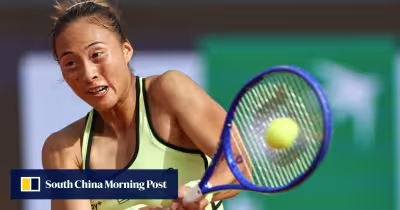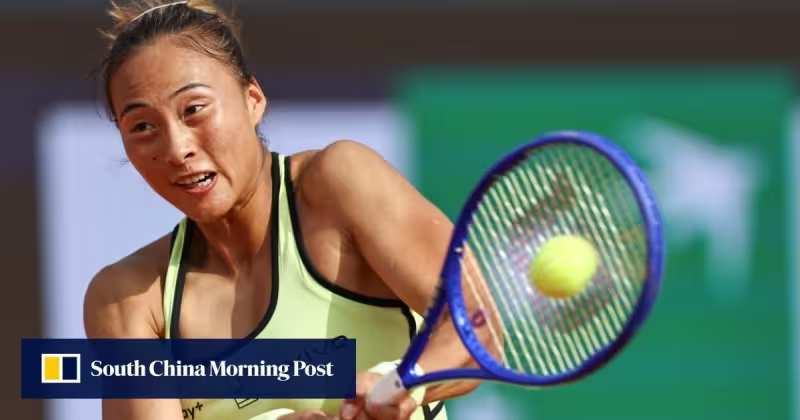
Qinwen Zheng arrived at Roland Garros this week as a 23-year-old Olympic champion but no longer a seeded player — she sits at world No. 53 after a 21-place fall that will leave her unseeded at the French Open.
The numbers are abrupt. Zheng won gold at Roland Garros during the 2024 Games in Paris, yet she has won only three matches in the last two months and dropped 21 spots in Monday’s rankings. That slide leaves her vulnerable in the draw; as an unseeded player she could meet top names such as Aryna Sabalenka or Iga Swiatek early in the tournament.
On the practice courts in Paris and in front of reporters, Zheng did not hide her frustration. "The results haven't been exactly as I wanted," she said, and she acknowledged a pattern in recent defeats: "I feel like I still need that extra push, that extra energy in crucial moments because, as you can see, I lost the last two matches in the third set, both were very close."
Her case is not only numbers and outcomes. Zheng has been hampered by an elbow injury sustained last year and still is not fully recovered, a limitation that has shaped both her schedule and her form. Last week she lost to Jelena Ostapenko in the third round of the Italian Open, and rather than play a tune-up event the week before Roland Garros she trained behind closed doors in Paris.
That closed-door choice and the injury history are the context readers need: Zheng skipped match play immediately before the tournament, has a small recent win total, and now confronts a Grand Slam draw that will not protect her. Add to that the ranking math — falling out of the top 50 means no seeding — and the situation reads as a stumble for an athlete who climbed to the top here only months ago.
The larger tension in Zheng’s message is honest and sharp. She insists the stroke-making and the underlying level are intact but pins the shortfall on a mental edge. "I believe my level is there, the difference is mental because it had been a while since I last competed, and now I can finally maintain concentration for a long time throughout the entire match," she said. Yet the recent pattern — two close third-set losses and a quick exit in Rome’s third round last week — suggests the mental finish line has not yet been reached.
She has been specific about the work: "I have been working hard on that," Zheng said, referring to sustaining concentration and finding the extra energy in deciding moments. It is a plausible explanation: a player recovering from injury can regain technique before match toughness returns. It is also the risky one; avoiding a competitive week and training privately may have preserved her elbow but it did not produce wins when match pressure mattered most.
The question now is immediate and consequential: can Zheng convert the progress she describes into results on the red clay against a Grand Slam field that will not give her easy passages? If she does, the Olympic champion can reclaim form and justify the closed-door preparation. If she does not, the unseeded draw — which could pair her early with Sabalenka or Swiatek — will expose that the difference remains mental rather than physical.