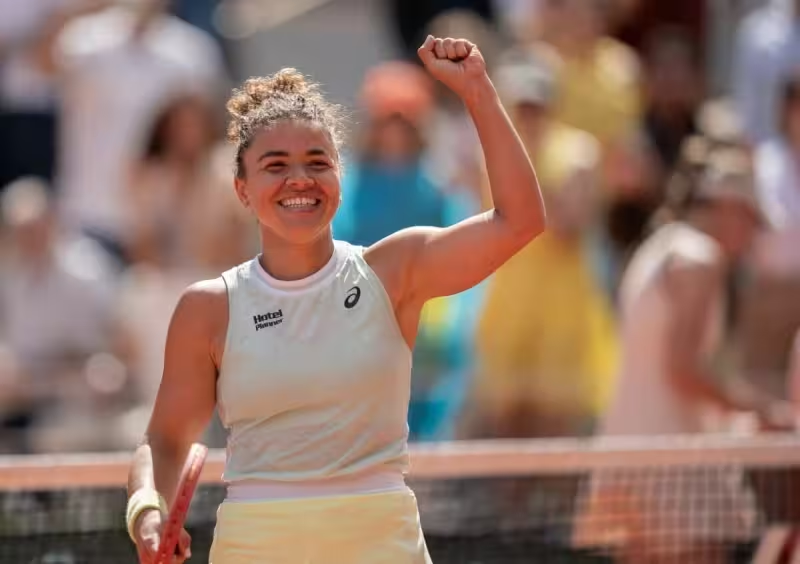
Jasmine Paolini will walk onto Court Philippe-Chatrier on 27 May 2026 at 11 a.m. to play Dajana Jastrems'ka in the first round of the Roland Garros singles draw, a match she has chosen to treat as the priority after electing to skip the doubles competition.
Paolini, 30 and 13th in the WTA rankings, has made no secret of the objective that brought her back to Paris: she wants to return to the WTA top 10 as soon as possible. She carries unusual recent credentials into that quest — she won Olympic gold on the same Rome court in 2024 and lifted the French Grand Slam doubles title last year alongside Sara Errani, who remains her friend, colleague and coach — but numbers and form offer a sharper picture of what lies ahead.
The recent ledger is mixed. Paolini left Stuttgart in tears after a 2-6, 2-6 defeat and suffered a foot injury during the Rome International, setbacks that have narrowed her focus to singles and led directly to the decision to forgo doubles here in Paris. Skipping the doubles match is a tactical move: it removes a distraction and preserves her body for the opener against a player ranked No. 45 by the WTA, the precise kind of match Paolini must win to restart upward momentum.
There is a clear tension between pedigree and pressure. On paper she has winning experience on clay and has shared big titles with Errani, but those doubles successes and the Olympic gold come with a cost — they are reminders of what she can achieve while highlighting how far her singles ranking has slipped from the top 10. Paolini has said she needs to raise her level; that is not a slogan but a requirement if she is to turn past doubles glory into sustained singles progress.
The Italian contingent at Roland Garros offers a study in contrasts. Matteo Berrettini is scheduled to face Márton Fucsovics the same morning Paolini plays, and an Italian derby between Flavio Cobolli and Andrea Pellegrino is set for no earlier than 15:00. Jannik Sinner opens his campaign against Clément Tabur. Other results already on the scoreboard underscore the tournament’s volatility: Lucia Bronzetti lost 3-6, 1-6 to Marie Bouzková; Mattia Bellucci went down 3-6, 6-7, 3-6 to Quentin Halys; while Federico Cinà defeated Reilly Opelka in a fifth-set marathon to claim his first Grand Slam match win.
All of which frames Paolini’s choice to concentrate on singles as less an experiment and more a necessity. If she advances from a seeded-perilous first round, the ranking points and confidence would be the immediate payoff; if she loses, the decision to skip doubles will be dissected not as conservative but as costly. Her preparation has been shaped by recent pain and recent triumphs on clay, and the collision of those histories will be settled at 11 a.m.
Paolini’s return to a singles path at Roland Garros is decisive: she has stripped back commitments, carries the experience of Olympic gold and a French Grand Slam doubles title with Sara Errani, and knows that a clear climb back into the top 10 depends on matches like the one against Jastrems'ka. That makes this opener more than a calendar item — it is the first concrete step in whether Paolini can translate past doubles and Olympic success into a restored singles standing.