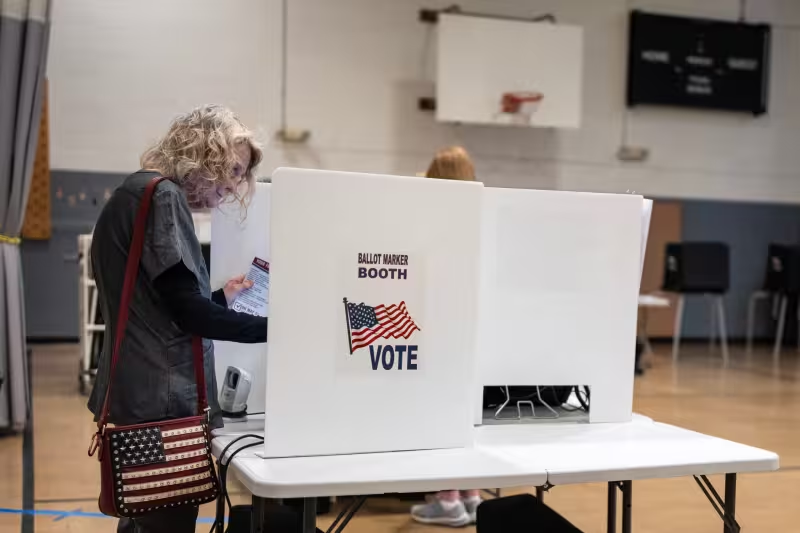
The Trump administration ran millions of voter registrations through Department of Homeland Security databases, routing at least 67 million registrations through an expanded verification program that flagged tens of thousands as potential noncitizens or people who have died.
One person caught by the sweep was Anthony Nel of Denton, north of Dallas, whose local election office temporarily canceled his registration last fall after Texas ran its file through the DHS system known as SAVE — even though Nel, who is from South Africa, became a citizen more than a decade ago.
The counting is stark: U.S. Citizenship and Immigration Services says SAVE was used to check 60 million registrations in a year’s time, and that more than 1,300 agencies rely on the system. Since April 2025, when the Trump administration significantly expanded SAVE’s search abilities, at least 25 states have used it to audit voter rolls. Tens of thousands of registrations flagged by those checks have resulted in immediate suspensions in some places, and some states give people only one month to prove their eligibility before removal.
Those numbers matter because they change how quickly and how broadly voters can be removed from the rolls. The Department of Justice has pushed states to hand over unredacted voter information for mass checks through SAVE, while the Trump administration has promoted a broader effort to federalize certain election functions and has called for a federal list of verified voters.
Freda Levenson warned of the practical consequences: "If a voter is wrongly removed, by the time they learn about it and correct it, they may miss their opportunity to vote in that election." Nel put it more bluntly: "I’m like, ‘You should know that I’m a citizen, that the passport exists,’" he said after his registration was suspended while he waited for a replacement passport.
SAVE — the Systematic Alien Verification for Entitlements — was created under an immigration law that requires DHS to help federal, state and local agencies prevent government benefits from going to noncitizens. U.S. Citizenship and Immigration Services says the system is used by more than 1,300 agencies, and that the recent expansion dramatically increased the program’s reach into voter registration records.
Advocates for voting and civil rights say the DHS system is error-prone and can mistakenly flag people who are eligible to vote; civil-rights groups are already pushing back in the courts. The ACLU of Ohio is challenging an Ohio law that would require monthly checks with SAVE, arguing the program’s mistakes risk disenfranchising lawful voters. At the same time, federal pressure and DOJ requests for unredacted files mean states are being asked to hand over more detailed personal information for mass verification.
The friction is built into the design: a system meant to stop ineligible people from receiving government benefits is now being pressed into service to police voter rolls, and it does so with blunt instruments. Some states respond to a SAVE flag by suspending registration immediately; others give the flagged person a month to prove citizenship. That uneven response turns the same flag into either a brief administrative hiccup or a de facto bar to voting, depending on where a person lives.
The immediate consequence is simple and unavoidable: eligible voters can be pulled off the rolls by a program that also catches citizens. What comes next is a fight between state election officials, courts and the federal agencies pushing the checks. Unless states change how they act on SAVE flags — for example by pausing suspensions while people can document their citizenship — the expanded program will remove eligible voters from rolls in numbers that the facts show are already substantial.
Anthony Nel, whose registration was restored after he documented his status, remains one example of what is happening at scale. His case answers the larger question the program raises: a federalized verification system can reach millions of records, but when it mistakes citizens for noncitizens the cost is not theoretical — it is the immediate risk that people will lose the ability to vote in elections they are entitled to decide.