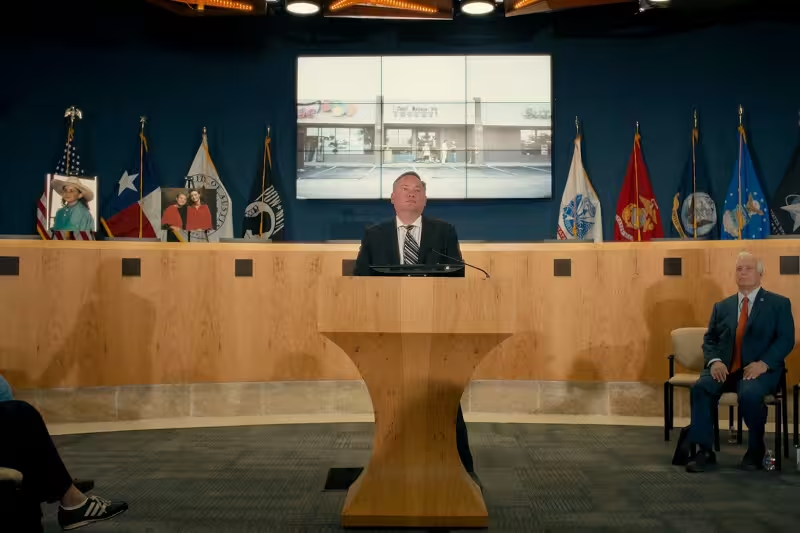
On September 27, 2025 Austin police announced they had solved the 1991 yogurt shop murders, identifying Robert Eugene Brashers as responsible for the slayings of four teenage girls — Amy Ayers, Eliza Thomas, Jennifer Harbison and Sarah Harbison — and for at least four other killings uncovered after his 1999 suicide.
Filmmaker Margaret Brown flew to Austin the same day to film the fifth episode of her HBO docuseries, titled "The End of Wondering." Brown had spent more than three years interviewing investigative teams and the victims’ parents and siblings while making the first four episodes. She said she was scared to return to Austin after police disclosed Brashers’ role and worried that the families would be retraumatized by the discovery; she found instead that they were more relieved than traumatized.
The scale of what changed is blunt: the murders went unsolved for 34 years before police tied the case to Brashers, who died in 1999. The case’s long arc also includes wrongful accusations and convictions — two men, Robert Springsteen and Michael Scott, were charged and convicted in 1999; those convictions were later thrown out. Forrest Welborn’s charges were dropped in 2000. Maurice Pierce was held on a charge for years and released in 2003; he was fatally shot by Austin police after a traffic stop in 2010. All four men were formally exonerated in February 2026, and on May 13 the city of Austin agreed to pay a total of $35 million in restitution to Welborn, Springsteen, Scott and Pierce’s family members.
Brown said the new episode focuses on how DNA evidence led investigators to Brashers and on the aftermath for families who had waited decades for answers. The first four episodes tracked down interrogation-room footage of Forrest Welborn, Maurice Pierce, Robert Springsteen and Michael Scott; Welborn and Pierce’s widow and daughter agreed to be interviewed for the fifth episode after declining to speak for the earlier installments. Deborah Brashers also agreed to be interviewed for the new episode.
Dan Jackson, the cold-case detective tied to the investigation, was interviewed by Brown about a year before police publicly announced they had figured out who did it, a timing that shows how long the inquiry into old evidence and new techniques had been underway. Supplementary reporting released with the announcement said Brashers was a serial killer whose crimes were uncovered after his death by suicide in 1999.
The human friction in this story is not only between evidence and time but between public relief and private damage. The discovery that Brashers was responsible confirmed what families had feared and suspected for decades, but it also exposed the toll of a criminal-justice system that produced wrongful charges, convictions and years of detention for men now formally exonerated. Brown said she worried the revelation would retraumatize relatives; instead she encountered relief and, she said, a release from the long uncertainty the families carried.
Tension remains. The convictions from 1999 were overturned only after years of legal fight and renewed scrutiny; some men spent years held on charges before being released. The city’s $35 million settlement in May acknowledges that official mistakes compounded the original crime. The fifth episode, Brown said, is part catalog — the case’s fractured investigations and recorded interrogations — and part reckoning with what it costs to wait decades for a name.
For the families who told their stories on camera and for Brown, the difference is concrete: the series’ latest installment is titled "The End of Wondering" because, in Brown’s telling, the identification of Robert Eugene Brashers finally answered the question that shaped three generations. That, for the people who lived it, is the story’s final measure — not only who killed those four girls in 1991, but whether the waiting has at last stopped.