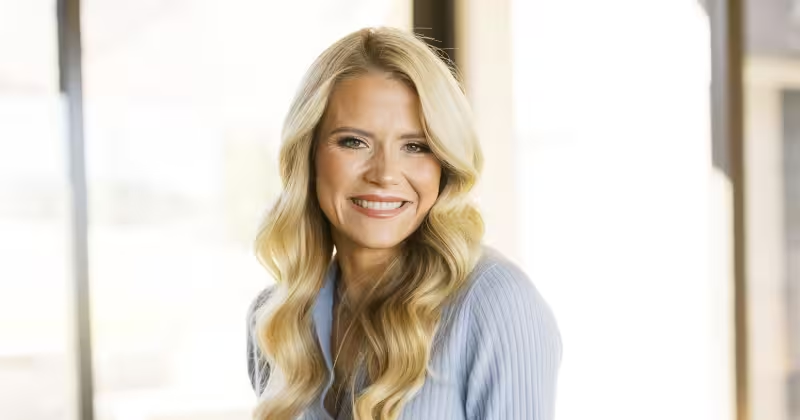
Elizabeth Smart said this week that photos from a recent bodybuilding competition have reshaped how people see her — and that surprised her.
Smart posted images from the April event showing her in a blue bikini, sky-high heels and a deep tan; the pictures, which she later shared on April 21, went viral and drew thousands of comments, she said, eclipsing the attention she received for a Netflix documentary, media appearances and her December memoir, Detours.
"I could not believe the response," Smart said, adding the competition was her fourth time competing. She said she had kept that part of her life private because "I always felt like there was a way I needed to present myself," and that for a long time "I would say 90 percent of it was fear [of how people would respond]."
Smart, who was kidnapped at knifepoint from her Salt Lake City bedroom at age 14 by drifter Brian David Mitchell and held for nine months in makeshift campsites in the Utah mountains and in San Diego, has long been publicly identified as a survivor of one of the country's most notorious child abductions. During her captivity she was raped and endured repeated abuse from Mitchell and his accomplice Wanda Barzee; she was rescued in 2003.
The viral images reopened the question Smart has answered in public for years: how to live beyond the label of "kidnapping survivor." "Bodybuilding has helped free me," she said. "I am not just a victim or a kidnapping survivor." She added, "I’m not just one thing. I am many things."
The reaction was not uniformly celebratory. Smart said she had been debating whether to comment after a repost over the weekend by a program director at her foundation named Miyo, and that she had received a flood of direct messages asking, "What are you doing? Why are you doing this? Is this AI?" She said, "I’ve had enough DMs [asking], 'What are you doing?' 'Why are you doing this? 'Is this AI?'"
Smart framed the reveal as an expression of agency. "I don’t want to live a life where I was too afraid to actually live," she said. "I want to make the most of it." The bodybuilding photos, she said, drew more immediate engagement than projects that had been positioned to define her public work, including her documentary and her memoir, Detours.
That contrast is the tension beneath the story: the same public that recognized her as a survivor of a violent crime has been quick to police her appearance and choices. Smart said people have even made comments when she is at a pool in her bikini, a scrutiny that shaped her choice to conceal competitive bodybuilding until now.
Smart is married to Matthew Gilmour and is a mother to three children, Chloe, James and Olivia. The personal stakes explain why the response to the photos landed so heavily: for someone whose life was once controlled by others, visibility now risks both reclaiming and misreading her body and identity.
What happens next is clear from Smart’s own words: she intends to keep competing and to keep expanding how the public sees her. The facts of her abduction remain unchanged, but Smart’s answer to being defined by that moment is explicit — she has chosen to live beyond it. "I am not just a victim or a kidnapping survivor," she said. "Bodybuilding has helped free me."