The United States paused a $14 billion arms sale to Taiwan, Deputy Secretary of Defense Hung Cao said on May 21, telling reporters the hold was meant to preserve munitions for the war in Iran. "Right now we’re doing a pause in order to make sure we have the munitions we need for Epic Fury – which we have plenty," Cao said, adding that "the foreign military sales will continue when the administration deems necessary."
The pause, announced about a week after former President Donald Trump’s visit to Beijing, came amid significant pressure from China and followed Chinese state media warnings that mishandling the Taiwan issue could spark conflict. The shipment had been expected to include equipment vital to Taiwan’s defense, and Taipei described the move as consequential to the island’s security posture.
Numbers underline the stakes: the package at the center of the pause was worth $14 billion, while the State Department on the same day approved a separate $100 million missile-system sale to Ukraine. The United States remains one of Taiwan’s only arms suppliers, and the Taiwan Relations Act requires Washington to provide the island with the means to defend itself.
For Taipei the message was mixed. Taiwan’s presidential office spokesperson Kuo Ya-hui said, "Taipei has not received any information indicating that the US intends to make any adjustments to the sale." Cho Jung-tai, a senior Taiwanese official, said Taipei would "continue to pursue arms purchases." President Lai Ching-te later told reporters that "No country has the right to annex Taiwan" and that "Democracy and freedom should also not be seen as provocation."
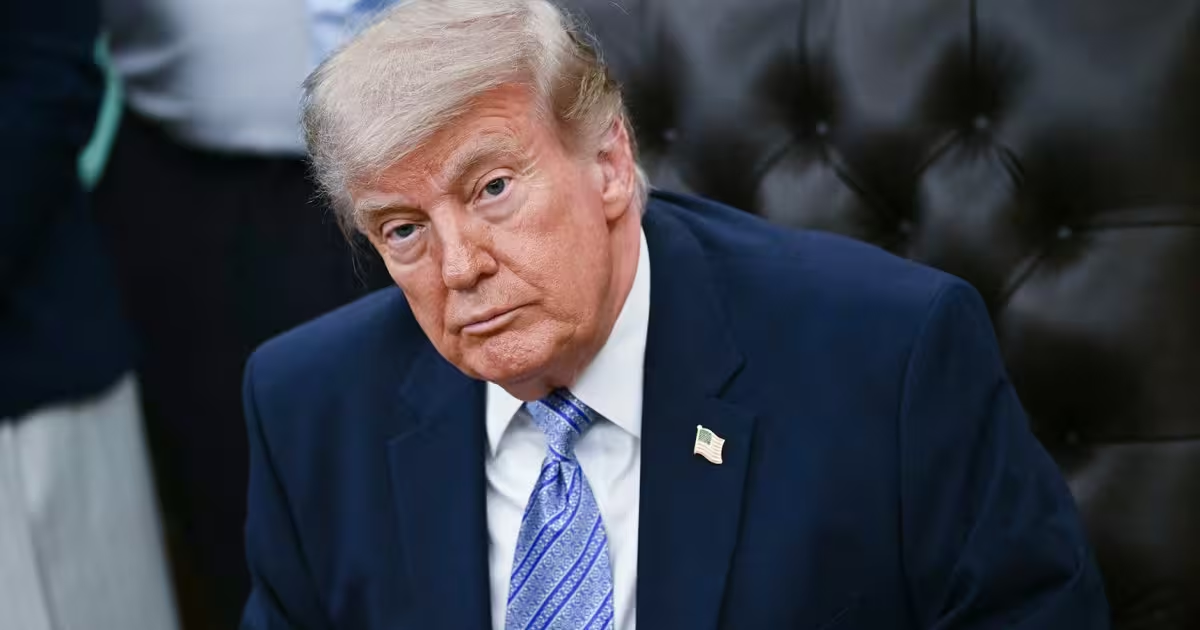


The timing deepens the geopolitical read. The hold followed a week in which Trump discussed Taiwan extensively in Beijing and in U.S. media, calling the package "a very good negotiating chip" and saying he would "speak to the person that right now is, you know who he is, that’s running Taiwan." Trump also said, "I’ll speak to him. I speak to everybody... We’ll work on that, the Taiwan problem." Those comments have drawn scrutiny because they touch on the Six Assurances from 1982, which said the United States would not consult with China on arms sales to Taiwan.
The pause also produced immediate skepticism in Taipei. Opposition lawmaker Chieh Chung criticized the rationale, saying, "Using an arms sale to Taiwan that hasn’t even been notified to Congress and hasn’t been included in the production plan as the target is extremely far-fetched and seems more like an excuse." Chinese officials, meanwhile, kept up pressure: Guo Jiakun, a spokesperson for China’s foreign ministry, urged the U.S. to abide by the One China principle and warned that "Attempts to seek independence by soliciting foreign support or through military means are ultimately nothing but wishful thinking." Chinese state media had published warnings that poor handling of the Taiwan issue could lead to confrontation with the United States.
Washington framed the move in narrowly logistical terms. U.S. officials said equipment was being held so stockpiles could be conserved for operations tied to the war in Iran — referenced in public comments as Epic Fury — and that future foreign military sales would proceed when the administration determined they should. Hung Cao put it plainly: "We’re just making sure we have everything, but then the foreign military sales will continue when the administration deems necessary."
The pause forces a practical choice on Taipei. The island depends on American suppliers for much of its defensive kit, and Washington has repeatedly pledged to help under U.S. law. Taipei’s leaders insist they will keep seeking arms even as they try to manage relations with Beijing. The central unanswered question now is whether Washington intends this pause as a one-off to restock for Epic Fury or as a durable bargaining chip in broader talks with Beijing — a decision that will shape Taiwan’s security calculations and the futures of U.S.-China diplomacy.