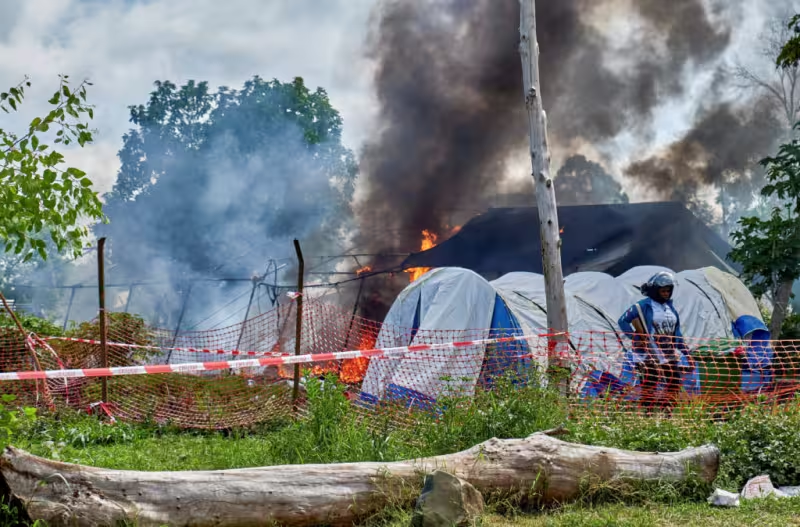
Residents set fire to an Ebola treatment center in Rwampara, eastern Congo, on Thursday after being stopped from retrieving the body of a local man, Jean Claude Mukendi said.
The blaze followed a confrontation between youths and staff at the treatment center; an journalist saw people break into the center, set fire to objects inside and to what appeared to be the body of at least one suspected Ebola victim while aid workers fled the site in vehicles.
The numbers driving the alarm are stark: Congolese authorities reported 160 suspected deaths and 671 suspected cases across two provinces, and the World Health Organization has declared the outbreak a public health emergency of international concern, saying it is almost certainly much larger and expressing alarm at the speed of spread.
Witnesses said the attack began when family and friends tried to take the body of a man who had apparently died of Ebola from the center. "His family, friends, and other young people wanted to take his body home for a funeral even though the instructions from the authorities during this Ebola virus outbreak are clear," Mukendi said. He added, "All bodies must be buried according to the regulations."
Alexis Burata, speaking about the scene, said police tried to intervene. "The police intervened to try to calm the situation, but unfortunately they were unsuccessful," he said, and later: "The young people ended up setting fire to the center. That's the situation." The attack left aid teams temporarily displaced and local security forces struggling to enforce burial protocols meant to limit transmission.
Later on Thursday Hama Amadou said calm had been restored and that aid teams were continuing their work at the center, but the incident highlights how public health orders can collide with local funeral customs at a moment when responders say every case matters.
The outbreak has been spreading for weeks in a region with inadequate health facilities and widespread movement of people fleeing armed conflict — conditions that both complicate care and raise the risk of further transmission. Earlier in the week the U.N. reported two cases, including one death, in neighboring Uganda, underscoring how quickly the virus can cross borders in a volatile area.
The burning of the Rwampara facility deepens a familiar tension in Ebola responses: authorities insist on regulated burials because uncontrolled funeral rites are a major transmission route, but families insist on traditional funerals and the right to reclaim the dead. That clash is what precipitated Thursday's violence, and it helps explain why responders have struggled to keep pace with the outbreak despite international alarm.
The consequences are immediate. Aid workers who fled in vehicles returned after authorities and local leaders worked to restore order, but the destruction of treatment beds and supplies will slow testing, isolation and safe burials precisely when the WHO says there may already be many more cases than official counts show.
Outside reporting on other hospital stories has been vivid this month: actress Kate Mansi exited General Hospital after three years, and comedian Kathy Griffin said she spent a night in hospital after a colonoscopy — reminders that hospitals are where public health and personal grief meet in very different ways. In Rwampara the stakes are life and containment: if local communities will not accept regulated burials and safe treatment at makeshift centers, the outbreak response will be impossible to sustain.
The most consequential question now is whether Congolese authorities and international health agencies can rebuild trust on the ground quickly enough to enforce burial rules, restore secure treatment capacity and prevent further spread; until that happens, every new case risks multiplying the crisis.