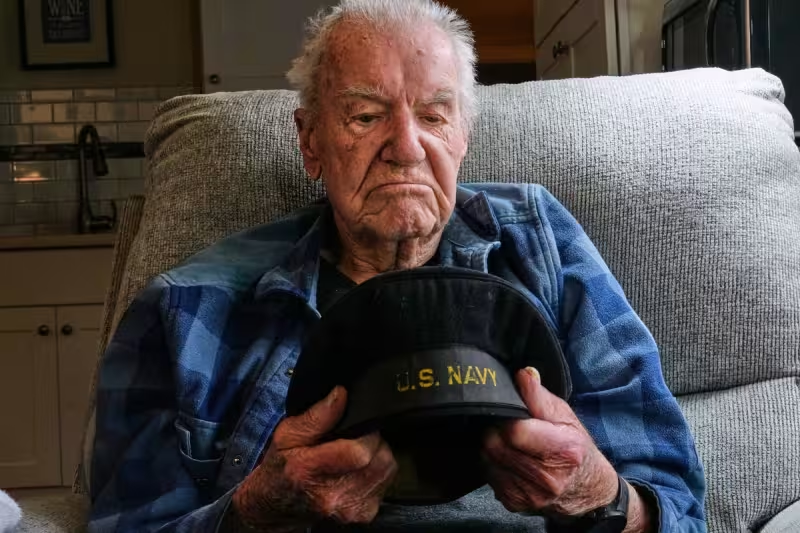
Freeman Johnson, 106, is the nation’s oldest living survivor of the Pearl Harbor attack after the death in December of fellow World War II Navy veteran Ira "Ike" Schab, authorities say. Johnson lives in Centerville, Massachusetts and was below deck repairing a boiler on the USS St. Louis when Japanese planes descended on December 7, 1941.
Johnson never witnessed the surprise assault firsthand. "While all the rigamarole was going on topside, I was inside a steam drum. Couldn’t see anything, absolutely nothing," he said, recalling a day that killed just over 2,400 troops and reshaped a nation.
By the time Johnson emerged, the light cruiser St. Louis had already evaded midget submarines and was making its escape to sea. He said he did not hear the anti-aircraft guns of his shipmates firing at the attacking aircraft. "We were way out to sea, way out. You couldn’t see any land at all. All you saw was ocean," he said, placing himself physically and emotionally apart from the explosions and smoke that defined the harbor that morning.
Johnson described his role and his place in the ship’s hierarchy plainly. "I was just a sailor, just a swabbie, I was not an officer. They don’t tell you anything if you don’t need to know. And I didn’t need know it. So they tell you nothing," he said. The remark underscores why he never learned the full picture in the moment and why his memory of the attack is a narrow, interior one.


His calm has the ring of habit. "You’re not scared. You’re too busy to be scared. Besides, you don’t know what you’re scared of. You can’t see anything. What are you afraid of?" Johnson said, summing up the practical stoicism that has marked his account for decades.
The gravity of Johnson’s title is measurable. Only 11 survivors of the Pearl Harbor attack remain. The assault killed just over 2,400 troops and took place on an island that had roughly 87,000 troops stationed on Oahu on December 7, 1941. The circle of witnesses has been closing for years: approximately 2,000 survivors attended the 50th-anniversary Pearl Harbor event in 1991; in recent decades only a few dozen have appeared at remembrance ceremonies; in 2024 just two survivors made the journey to Hawaii, and last year none could make the pilgrimage.
For much of his life, Johnson avoided public attention and rarely spoke about that day. His wife, Ruth, thought his story was "something special" and called the Navy; a Navy employee on the phone laughed when she recounted it. That private history has shifted. Johnson’s 106th birthday brought him an arrival in a limousine and television cameras. He now receives letters from across the globe and is routinely hailed as a hero wherever he goes.
The tension in Johnson’s story is simple and human: a man who says he was a low-ranking fireman and who could see nothing of the assault has become, by dint of survival and age, a public face for an event he barely observed. Institutions press for firsthand testimony even as his own words insist he had no overview and was kept in the dark. The Navy’s shrug in Ruth’s phone call — and the absurdity of cameras greeting a man who says he "didn’t need know" — highlight how memory and commemoration can lift someone into the spotlight whether he sought it or not.
As one of 11 remaining survivors, Johnson’s presence now matters in a new way: his account is a narrowing thread of lived history that will soon be cut. With survivors returning to Hawaii in ever-smaller numbers and the generation that lived Pearl Harbor dwindling, ceremonies and classrooms will increasingly rely on recorded testimony and archival material rather than living witnesses. Johnson’s short, blunt recollections — and the public response to them — are a bridge between that living past and the institutional preservation of memory that must follow.