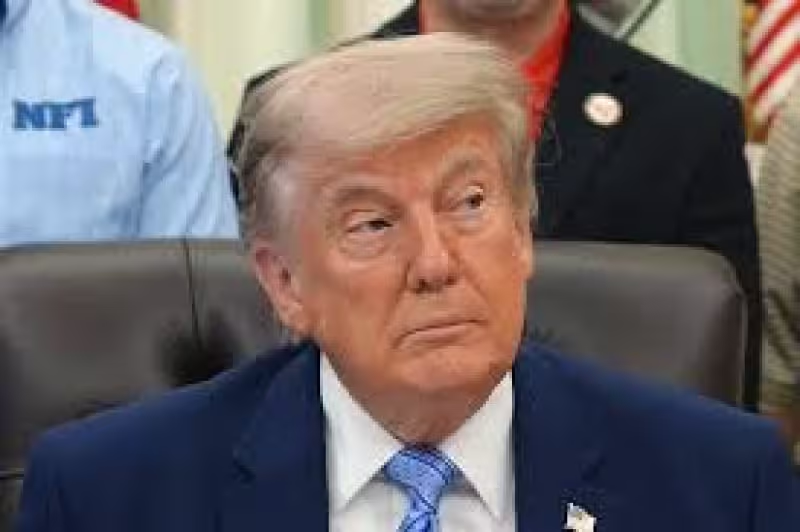
President Donald Trump said on Thursday that the United States will send an additional 5,000 troops to Poland, posting the announcement on Truth Social and tying the decision to the recent Polish election and his relationship with its new leader. "Based on the successful Election of the now President of Poland, Karol Nawrocki, who I was proud to Endorse, and our relationship with him, I am pleased to announce that the United States will be sending an additional 5,000 Troops to Poland," Trump wrote.
The number is striking because it comes after a series of moves that had already shrunk U.S. force presence in Europe. The Trump administration had said it was reducing levels in Europe by about 5,000 troops, and U.S. officials confirmed that about 4,000 service members were no longer deploying to Poland. As of last week, some 4,000 troops from the Army’s 2nd Armored Brigade Combat Team, 1st Cavalry Division were no longer en route to Poland, and a deployment to Germany of personnel trained to fire long-range missiles was halted.
Those figures have left allies and lawmakers searching for clarity. Trump and the Pentagon have said in recent weeks that they were drawing down at least 5,000 troops in Germany; at the beginning of the month, Trump told reporters the United States would be "cutting a lot further than 5,000." The apparent reversal Thursday does not come with a clear list of which units will move, when they will arrive, or whether they replace the soldiers whose deployments were called off.



Context for the announcement matters: the Pentagon has already reduced the number of brigade combat teams assigned to Europe from four to three, a change the department says explains part of the force shifts. Officials and military planners had been grappling with that realignment when earlier decisions halted troop movements and adjusted mission sets across the continent during the four-year-old war in Ukraine. Those shifts prompted unease among NATO partners about the consistency of U.S. commitments.
The policy picture is jagged. On Tuesday, Pentagon spokesman Sean Parnell described the halted Poland movement as "a temporary delay," called Poland "a model U.S. ally," and said the reduction in Europe was a result of the U.S. reducing the number of brigade combat teams assigned to Europe from four to three. Yet lawmakers from both parties have criticized the earlier cuts as ill-timed. Republican Rep. Don Bacon of Nebraska said Polish officials were "blindsided," adding the decision was "reprehensible" and "an embarrassment to our country what we just did to Poland." Those sharp reactions underscore a gap between public statements of reassurance and the operational choices already implemented.
That gap is the central tension now: a presidential declaration of 5,000 more troops to Poland set against recent Pentagon moves that removed roughly that same number from the region. U.S. officials have acknowledged about 4,000 service members were no longer deploying to Poland, and planners stopped a Germany deployment of long-range missile-trained personnel. The question is not just arithmetic but sequencing and intent — which units will be sent, whether they will restore the posture allies expected, and how fast they will arrive.
The next step is straightforward and urgent: the Pentagon must spell out which forces will move, when, and for how long. On Tuesday, Parnell said the Pentagon still needed to decide which troops to station where; Thursday’s public announcement tightens the deadline on that internal calculation. Without that clarification, the announcement will sit as a powerful political gesture with limited operational meaning — and it will do little to erase the confusion lawmakers say has already damaged U.S. credibility with an anxious ally and with partners watching the four-year-old war in Ukraine.