President Donald Trump’s administration spent Friday preparing for a fresh round of military strikes against Iran while keeping a diplomatic window open, though no final decision had been reached as of Friday afternoon.
The preparations were concrete: some members of the U.S. military and intelligence community canceled Memorial Day weekend plans, defense and intelligence officials updated recall rosters for U.S. installations overseas, and tranches of troops already stationed in the Middle East were rotated out of theater as part of a separate effort to reduce America’s footprint. At the same time, the White House transmitted a proposal to Tehran this week that a U.S. official said was accompanied by a warning that rejecting the final offer would mean military strikes would resume.
White House spokesperson Anna Kelly framed the choice in stark terms. She said Mr. Trump had "made his redlines abundantly clear: Iran can never possess a nuclear weapon, and they cannot keep their enriched uranium." Kelly added that "The President always maintains all options at all times, and it is the job of the Pentagon to be ready to execute any decision the Commander-in-Chief could make," and that "The President has been clear about the consequences if Iran fails to make a deal."
The stakes are immediate. A temporary ceasefire between the United States and Iran has held since early April, and the latest U.S. proposal — transmitted on Wednesday — was explicitly linked to an ultimatum: accept the terms or face a resumption of strikes. Iran’s Islamic Revolutionary Guard Corps warned on Wednesday that any further strikes from the United States or Israel could widen the conflict beyond the Middle East, threatening what it called "crushing blows … in places you cannot even imagine."
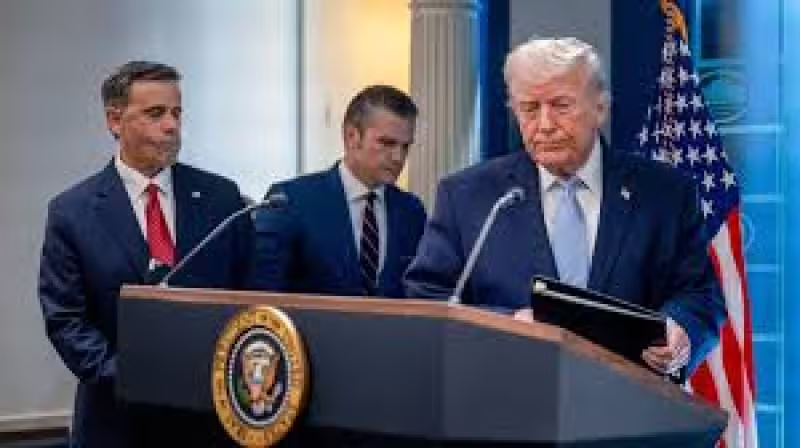
President Trump kept pressure on Tehran while signaling he preferred a deal to more fighting. On Wednesday he said he was prepared to give Tehran "a couple of days" to respond to the latest U.S. offer; on Friday he told reporters, "Iran is dying to make a deal," and added, "We'll see what happens." Secretary of State Marco Rubio, before boarding a flight to India, said the U.S. expected to receive a response via the Pakistani field marshal and described the fallback discussions being held with allies in Sweden about how to reopen the Strait of Hormuz as "Plan B." Rubio also told associates that Mr. Trump preferred diplomacy to strikes.


The contrast inside Washington is striking. Officials who update recall rosters and who canceled holiday plans are running worst-case logistical preparations even as senior figures in the administration publicly push for a negotiated end to nearly three months of fighting. House Republicans on Thursday abandoned an effort to hold a vote, signaling fractures in Congress over how to proceed.
There is a tactical tension in the administration’s posture. On one hand, tranches of troops are rotating out of the Middle East in a bid to shrink the American footprint; on the other, steps taken Friday — cancellations, recall lists and the mobilization of planning resources — suggest the Pentagon is being readied to move back into action on short notice. The White House’s ultimatum and the IRGC’s threat to widen the war mean that any move by Washington could quickly escalate.
The context sharpens the consequences. Since the ceasefire began in early April, U.S.-Iranian strikes have largely stopped, but the conflict has already rattled global energy markets and contributed to soaring fuel prices. The latest proposal’s link to an explicit threat of renewed attacks undercuts the idea that diplomacy alone will settle the crisis unless Tehran accepts terms that satisfy the administration’s stated redlines.
What matters now is whether Tehran answers the proposal within the timetable Mr. Trump set and whether that answer satisfies the administration’s conditions. If Iran rejects the offer, the Pentagon — which the White House says must be ready to act — is positioned to resume military operations in response to the ultimatum. If Tehran accepts, the ceasefire that has largely held since early April could become the basis for a longer pause.
For now, Americans watching from home will see a White House that has warned of consequences, a president saying he prefers a deal but prepared to act, and military planners canceling holiday plans while they wait. The single immediate question is sharpened by those facts: will Tehran take the deal Mr. Trump offered in "a couple of days," or will the engines of war, kept on standby through Memorial Day preparations, have to be restarted?