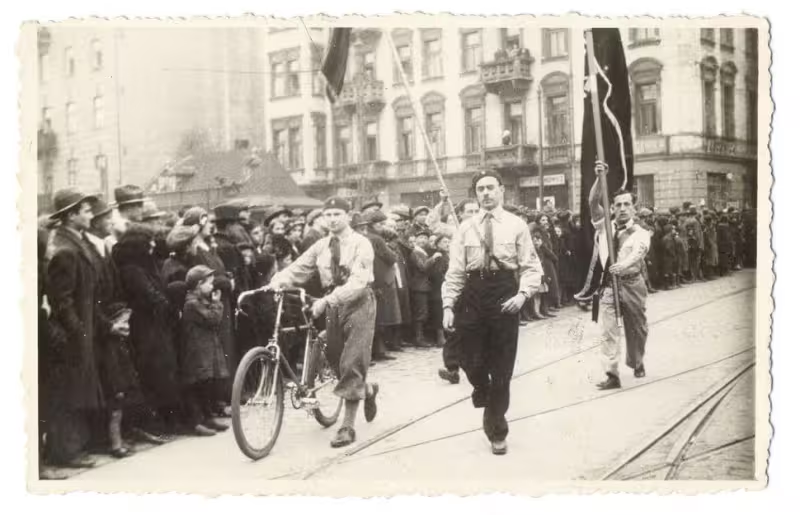
The Forward’s review of Molly Crabapple’s Here Where We Live Is Our Country calls it a captivating read, but also says the book turns nearly 130 years of Jewish Labor Bund history into a sharply divided political canvas. Crabapple traces the movement through revolution, war and exile, using her great-grandfather, Sam Rothbord, as a guide to the vanished world of Jewish Eastern Europe.
Rothbord was born in Volkovysk, now in Belarus, joined the Bund as a young man, then immigrated to America and became an artist. His first exhibit was held at the former headquarters of the Forward on East Broadway, a family link that gives the book some of its strongest emotional force. Crabapple also brings in Vladimir Medem, Arkady Kremer, Raphael Abramovitch, Mark Lieber, Sophie Dubnova-Erlich, Henryk Erlich and Viktor Alter as she moves through the Russian revolutions of 1905 and 1917, World War I, the rise of the Polish republic and the Holocaust.
The review says that sweep is one reason the book reads so vividly. Crabapple synthesizes memoirs and documents into a lively narrative full of color and emotion, and the reviewer says she is well-versed in Marxist theory. That grounding, the review notes, comes partly from her father, whom she writes is a professor of political economy. Crabapple also often draws parallels between her own life as a left-wing activist and the struggles of radicals around the world today, giving the book a present-day charge that goes beyond family history.
But the review argues that the book’s energy comes with a cost. It says Crabapple often paints the historical landscape in black and white, with the Bundists cast as the good guys and governments, the Bolsheviks and the Zionists as the bad ones. In her account, the West and its capitalist, imperialist regimes are to blame for the world’s ills. The reviewer says that framing makes the book feel more like an argument than a balanced history, even when the storytelling is compelling.
The sharpest criticism is reserved for Crabapple’s treatment of Russian Jewish history. The review says she writes that Tsar Nicholas I set policies with the declared aim of forcing a third of Jews to die, a third to emigrate and a third to convert to Christianity. It says Nicholas I never made such a declaration and had in fact died by 1855, while emigration from Russia was strictly prohibited. The review also says he did not limit the number of Jewish students in Russian universities, and that the so-called percent norm was first introduced by Alexander III in 1887. It adds that popular books sometimes attribute the death-emigration-conversion line to Konstantin Pobedonostsev, though no documentary source supports it.
Those objections do not erase the book’s pull, and the review makes clear why it has readers in its grip. It describes one scene from the pogrom era in brutal detail: “Blood-smeared Russian mothers loaded their pushcarts with the spoils from looted Jewish houses, then had their kids torch their homes behind them as they left.” The line captures the book’s method and its limits at once — immersive, emotional and forceful, but also willing to press history into a moral shape that the evidence does not always fully support.
For readers drawn to the Bund, to family memory or to the politics of the Jewish left, the book offers an unusually vivid passage through a vanished world. The review’s bottom line is that Molly Crabapple has written a gripping, richly drawn history — one that is strongest when it lets Sam Rothbord and the people around him speak through the record, and weakest when it bends that record to fit a tidy ideological frame.