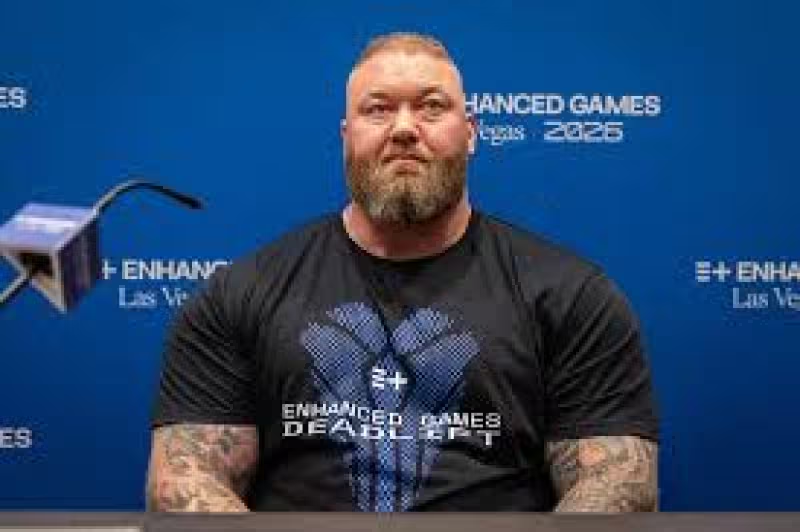
The inaugural Enhanced Games begin Sunday in Las Vegas, where dozens of elite athletes will compete openly while using performance-enhancing drugs in track, weightlifting and swimming.
Hafthor Bjornsson, the former strongman who deadlifted 510kg in competition, said he hopes to break his own 510kg record at the games — a bellwether moment for an event built on an unusual promise: winners will receive cash prizes, and world records in certain events will carry a $1 million bonus.
The weight of the project is immediate. Organizers say about $25 million in prize money is available across events, and founders Aron D'Souza and Maximilian Martin — who launched the Enhanced Games in 2023 — have drawn high-profile backing, including billionaire Peter Thiel and Donald Trump Jr.
The enhanced games schedule lists track, weightlifting and swimming among the headline sports, and organizers answered media questions at Resorts World casino before the first lifts and heats at a new open air arena in Las Vegas.
Organizers and some athletes insist the event will be transparent. Shania Collins, one of the athletes signed to compete, said: "We're being up front and honest and transparent from the start," and asked, "So how can you challenge our integrity when we're forthright with the information?"
That purported transparency collides with existing anti-doping rules. Testosterone and human growth hormone are banned by the World Anti-Doping Agency but, according to organizers and reporting on the event, are being encouraged and are for sale at the games. Organizers also acknowledge that some drugs used at the event must be legal and approved by the Federal Drug Administration.
The friction is no abstraction. Anti-doping officials and parts of the Olympic movement have publicly rebuked athletes who chose to compete, and health experts warn anabolic steroids and growth hormones can cause strokes and cardiovascular damage. Travis Tygart, a leading anti-doping official, framed the choice starkly: "You don't have to be pressured or use drugs in order to be the best," and added, "We don't want kids to have to say, 'in order to win an Olympic medal, when I'm 18 or 20 years old, I have to inject myself every day in the rear end with a potentially dangerous drug.'"
For athletes the calculus is simple and raw: competing under an explicit set of rules that permit substances banned elsewhere, for a multimillion-dollar purse and seven-figure bonuses, changes the incentives that govern elite sport. Dozens of elite competitors will trade the anonymity of private doping for public performance and cash prizes at a level the traditional system does not offer.
The most immediate tension is legal and reputational. By openly promoting substances that wider sport labels illegal or dangerous, the Enhanced Games forces sports federations, regulators and event partners to answer whether enforcement or accommodation is the path forward. Sporting governing bodies have already spoken out against athletes who chose to attend, but the presence of $25 million in prize money and a $1 million world-record bonus raises the real possibility that more athletes will prioritize those rewards over existing bans.
This matters today because the event turns an ongoing debate into a public experiment: will an organized, cash-rich alternative that permits banned substances redraw the boundaries of elite competition? The Enhanced Games founders and backers bring money and attention; the athletes bring names and records; the medical and anti-doping authorities bring warnings and rebukes.
What happens next is now unavoidable. Records attempted under permissive rules will force a showdown about recognition, insurance, health oversight and the future of elite sport. For Bjornsson, who says he aims to top 510kg, the contest is more than a contest — it is the point at which an alternative model meets consequences. The Enhanced Games will not merely run a calendar; it will compel federations and regulators to choose whether to counter, contain or quietly accommodate a new market for drug-permitted sport.