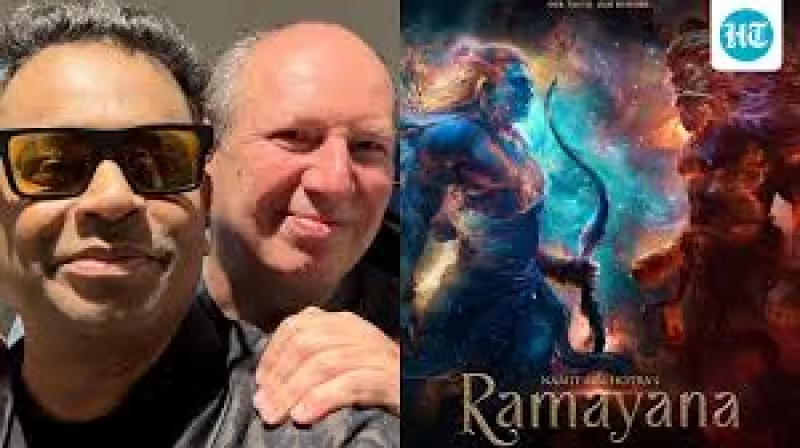
AR Rahman said his collaboration with Hans Zimmer on the forthcoming film Ramayana is "an epic collaboration," and he told interviewer Faridoon Shahryar that Zimmer's involvement will bring international attention to the project.
Rahman described bringing Zimmer onto a film rooted in Indian culture as almost like bringing an ambassador to the world, and said the composer's name will make many people watch the movie. He called working with Zimmer a great honour and said Zimmer has set a benchmark that has inspired generations of musicians.
The scale of the production underlines Rahman's point. Ramayana is reportedly being produced on a combined budget of ₹4,000 crore, and it stars Ranbir Kapoor as Lord Rama under the direction of Nitesh Tiwari. The film will be released in two parts, with Part 1 scheduled for Diwali 2026 and Part 2 for Diwali 2027.
Rahman said Ramayana is one of the biggest films of his career and that seeing the trailer in 3D was unlike anything he has seen in Indian—or global—cinema, calling the audio-visual experience "incredible" and praising the music and sound specifically.
The wider context matters because Zimmer is a two-time Academy Award-winning German composer whose credits include scores for Interstellar, Inception, The Lion King, Gladiator and Dune. His profile, plus the reported ₹4,000 crore budget, changes how the film will be presented and received outside India: Rahman framed Zimmer's role as drawing non-Indian viewers who might not otherwise see an Indian myth adapted on this scale.
Rahman also flagged a tension built into that attraction. He emphasised that Ramayana is a film "our own, from our country and culture," while also noting that at least a certain section of the audience will tune in specifically to see what Hans Zimmer has done on an Indian movie. The friction is straightforward: the project is being pitched both as a domestic cultural epic and as a film seeking an international audience guided, in part, by the global brand of a non-Indian composer.
That dual purpose is not theoretical. Producers Namit Malhotra and Yash are backing the picture through Prime Focus Studios and Monster Mind Creations, and the two-part release plan targets Diwali in consecutive years, a slot that traditionally commands huge box-office attention in India. Rahman's expectation — that Zimmer's name will bring viewers beyond the regular audience for Indian mythology on screen — therefore comes with a measurable test date.
What happens next is clear and immediate: Ramayana Part 1 will be measured against the promise Rahman is making now. If Zimmer's presence and the film's visual scale deliver the cross-border curiosity Rahman predicts, the two-part release on Diwali 2026 and Diwali 2027 will likely convert that interest into significant global box-office and streaming attention. If not, the experiment of pairing a global film composer with a story positioned as distinctly Indian will raise questions about how best to marry cultural ownership with international reach.
Rahman's judgment is explicit: working with Zimmer is an honour and a milestone, and he believes the collaboration will bring new viewers to Ramayana. The film's budget, cast and release plan mean that assertion will be tested on Diwali 2026 — and Rahman, having called the partnership "epic," has staked his reputation on the outcome.