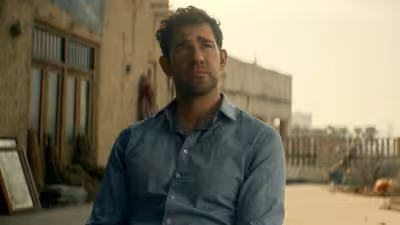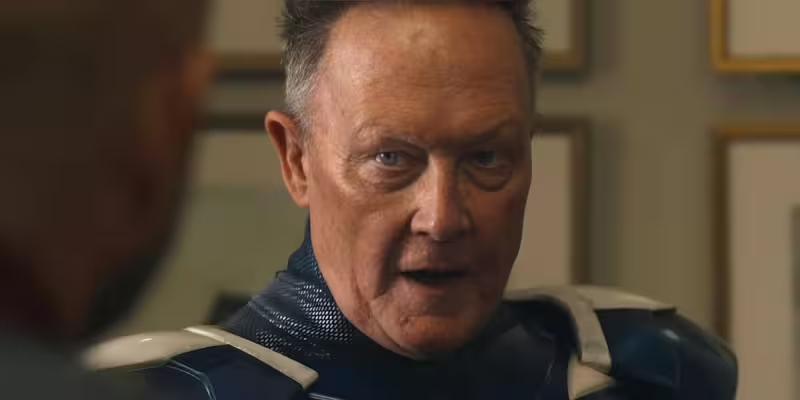
The series Peacemaker opens about five months after the events of 2021's The Suicide Squad with its title character discharging himself from a hospital and immediately finding A.R.G.U.S. agents on his trail — not to arrest him, but to recruit him for a new mission.
That opening matters because it puts Christopher Smith — the man who calls himself Peacemaker — back at the center of a federal operation even after he was shot in the throat by Bloodsport and left for dead in The Suicide Squad’s post-credits scene. The show's first moments answer two plain questions: he survived, and he is not free. A.R.G.U.S., acting on orders that tie back to Amanda Waller’s previous manipulations, sends a mismatched team to retrieve him.
Numbers and names make the case that this is more than a straight superhero follow-up. The timeline is explicit: 2021 established the original mission and the moment Bloodsport shot Peacemaker in the throat; the series begins about five months later with him recovering and then discharging himself from the hospital. The A.R.G.U.S. crew that tracks him is led by the stern Clemson Murn, with Emilia Harcourt — an agent who would rather punch first than have a meaningful conversation — and John Economos as the tech and logistics specialist. Leota Adebayo, played by Danielle Brooks, is on the team; as one character puts it plainly, “she is Waller’s daughter.” Adrian Chase, also known as Vigilante and played by Freddie Stroma, is part of the ensemble that will define the series’ interior friction.
Context follows the facts: the show positions Peacemaker as a DC counterpart to The Boys but with a more grounded perspective, expanding into a dysfunctional A.R.G.U.S. team rather than a single-mission squad. Viewers come into the story carrying what happened in The Suicide Squad — Peacemaker was recruited by Amanda Waller for an overseas mission, his secret assignment was to keep both the operation and the U.S. government's involvement hidden at all costs, and his later role in Rick Flag’s death put him at odds with teammates who survived. That history hangs over every exchange the series stages in its opening hours.
The tension in the first episodes is immediate and personal. On paper, A.R.G.U.S. approaches him to recruit him rather than arrest him; in practice, that is a contradiction. The man who once carried out a black-op mission meant to bury U.S. involvement is now being offered a place on a government team — and he returns to the world somewhat disillusioned with the very ethos he once voiced plainly: “the ends justify the means.” That contradiction gives the series its pulse: Peacemaker’s methods brought both victory and ruin, and the government that used him is not prepared to answer for what it asked him to do.
Those opposing pulls — a man who believes the ends justify brutal action, and the federal machine that views him as both asset and liability — set the stakes for what comes next. The show will track how he fits into a team assembled by A.R.G.U.S., into which Leota Adebayo, Clemson Murn, Emilia Harcourt, John Economos and Vigilante are already embedded. It promises to test whether a character shaped by secrecy and violence can be repurposed by the very authority he was meant to protect, and whether Waller’s desire to hide the government's role will again drive decisions that cost lives.
By returning Peacemaker to active duty rather than the dock, the series makes a clear choice: this will be a story about control as much as it is about redemption. If the opening is any guide, the show answers its central, unspoken question immediately — Amanda Waller and A.R.G.U.S. want him useful, not punished — and everything that follows will be about whether he accepts that bargain or explodes it. The result is not a tidy moral test; it is a setup for a character who must confront the concrete consequence of a creed he once embraced without question.