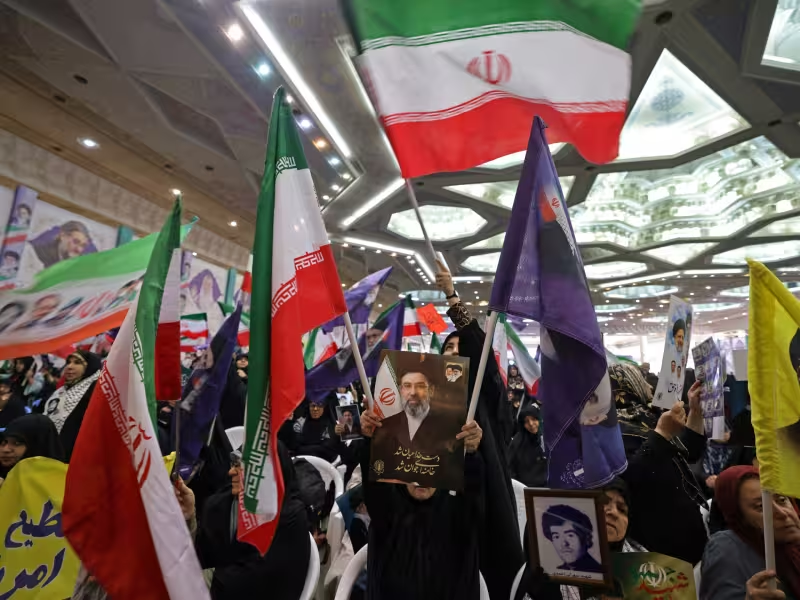
On Monday, May 25, 2026, Iran told reporters that Tehran and Washington had reached understandings on many issues in exchanges over a deal for ending the war, though Tehran warned an agreement was not yet imminent.
Esmaeil Baqaei, Iran’s senior foreign ministry spokesman, said: "It is correct to say that we have reached a conclusion on a large portion of the issues under discussion." He added bluntly that "But to say that this means the signing of an agreement is imminent -- no one can make such a claim," and accused Washington of "shifting its positions."
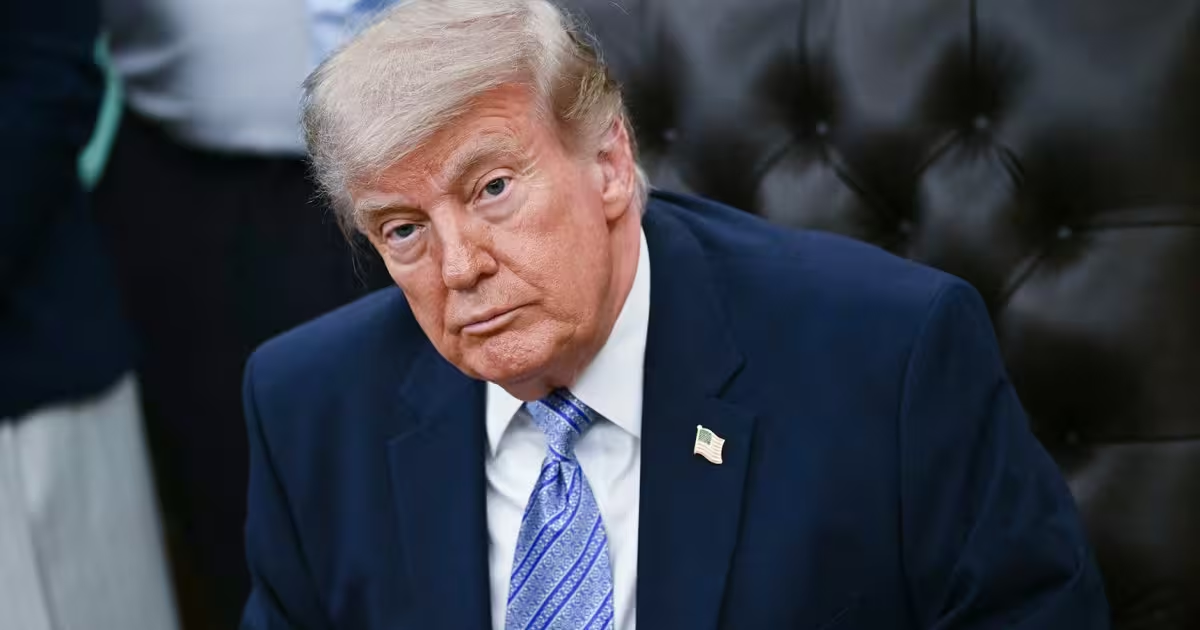
The announcement came as U.S. lawmakers and regional officials described a flurry of diplomatic activity that could produce a breakthrough. Senator Marco Rubio said on Monday a deal to end the war with Iran could materialize "today," and that "We have what I think is a pretty solid thing on the table in terms of their ability to open up the straits, get the straits open."
Rubio framed the package as broader than maritime access. "It has a lot of support in the Gulf.... Every country that we've walked through it (with) understands it's not just very reasonable, but it's the right thing for the world to get done," he said, and added that Iran would "enter into a very real, significant, time-limited negotiation on the nuclear matter." He warned that the U.S. would either reach a "good accord with Iran or deal with the country another way," but pledged to give diplomacy "every chance to succeed."
The competing tones — Tehran saying major issues are settled but not an agreement, Washington and partners signaling readiness to press ahead — reflect parallel mediation efforts this week. Pakistan’s army chief, Asim Munir, who traveled to Tehran on Friday and Saturday with Pakistan’s Interior Minister Mohsin Naqvi as part of ongoing mediation efforts to formally end the Iran war, was in Beijing on Monday with Prime Minister Shehbaz Sharif for talks with Chinese leaders.

Chinese state media cited by other outlets said President Xi Jinping met with Shehbaz Sharif on Monday, and Beijing publicly pledged to work with Pakistan to "make positive contributions to the early restoration of peace and stability in the Middle East." Pakistan’s role as an intermediary has gained prominence in recent days as Gulf states and Washington weigh incentives and guarantees to draw Iran into negotiations.
The weight of those signals is matched by on-the-ground friction: Israel’s military warned residents of 10 villages to evacuate their homes ahead of expected strikes against alleged Hezbollah targets, telling people they should move at least 1,000 meters away from the towns and villages to open areas. The Israeli military said the warning followed what it described as Hezbollah's violation of the ceasefire agreement, underscoring how fragile any diplomatic progress remains while military actors continue to respond.
The most consequential tension is simple and raw: Tehran says many issues are effectively resolved, but insists no one should assume a signature is near; U.S. and regional officials say a concrete proposal is on the table and could be adopted "today." That gap — between a claim of substantive progress and an insistence that nothing is settled — leaves a narrow window for mediators to convert understandings into an enforceable accord before battlefield dynamics and domestic politics pull the parties back apart.
Two threads will determine what happens next. First, whether Pakistan and China can translate shuttle diplomacy into a written framework acceptable to both Tehran and Washington; second, whether regional actors and Israel’s military responses restrain escalation long enough for negotiators to close remaining gaps. Readers following the iran war should watch diplomatic signals today: if Iran and the United States move to formalize understandings, the accords will likely hinge on guarantees around the straits and a time-limited nuclear negotiation; if talks stall, Washington’s alternatives — the outcome Rubio warned of — will quickly re-enter the center of calculations.
For now, Esmaeil Baqaei returned the story to where it began: plausible progress, held back by mistrust. His line — that much is settled but the signing is not "imminent" — is the clearest test of whether the current momentum will produce an agreement or merely postpone the next round of confrontation.