The Brazilian government on Monday pledged 3.1 billion reais — about $617.5 million — to expand Eco Invest, the blended-finance programme aimed at accelerating sustainable tourism, infrastructure and the bioeconomy in the Amazon. Environment Minister João Paulo Capobianco framed the move as part of the country's strategy to reach net-zero carbon emissions by 2050.
The commitment is immediate and concrete: the National Treasury will lend funds to banks at a low rate under Eco Invest, and those banks are expected to mobilize four times the amount lent in private investment. Officials also said foreign investors are expected to provide at least 60% of the contribution, and eight banks pledged another $2 billion in the latest Eco Invest auction held on Monday.
Eco Invest launched in 2024 to reduce investor risk by offering guarantees and has already committed 140 billion reais in combined public and private resources — roughly $28 billion. Planners say the programme uses blended finance to make costly, risky projects in the Amazon more bankable, scaling up everything from small cooperative production to tourism infrastructure in conservation areas.
Local producers could be direct beneficiaries. Carina Pimenta noted that credit under the scheme could help cooperatives that harvest and process Amazon goods, citing cassava derivatives, açaí and Brazil nuts, and could fund tourism facilities inside protected zones. Those aims are central to the government's pitch: join public guarantees and low-cost lending with private capital to create jobs while preserving forests that store carbon.
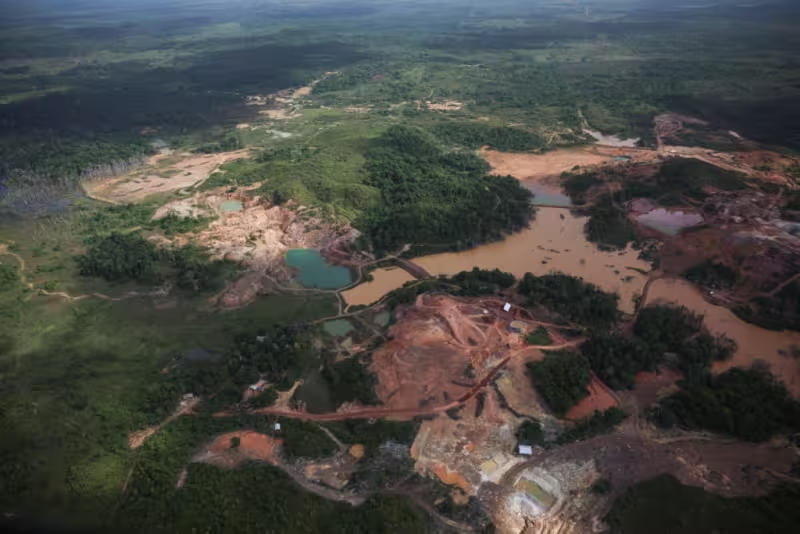
The Amazon matters to the plan because it houses more than 60% of Brazil's forest and plays an outsized role in regulating the global climate. Eco Invest's sponsors say directing capital to sustainable enterprises there helps Brazil meet its emissions target while supporting livelihoods in remote regions where projects are expensive and investors are cautious.
But the timing introduces friction. The financing announcement came after lawmakers fast-tracked bills that critics say could weaken environmental enforcement, a fact that raises questions about whether stronger legal protections will accompany a surge of money. Eco Invest reduces investor risk with guarantees and concessional loans, yet those same investors will be looking for predictable enforcement and clear rules on land use and conservation.
The programme's leverage targets are ambitious: officials expect the Treasury's low-rate lending to trigger four times in private finance, and foreign investors to supply at least 60% of contributions. If those multipliers hold, the government says public money will act as a force multiplier; if they do not, public exposure could rise without the promised private follow-through.
So far, the government points to a recent trend it says demonstrates progress: since 2023 Brazil has reduced forest loss without compromising productivity. Policymakers argue that combining that improvement with Eco Invest's guarantees will make sustainable projects more attractive. Critics counter that legislative shifts could undercut the legal certainty investors need to back conservation-linked businesses at scale.
The near-term picture is straightforward: the 3.1 billion reais pledge and the additional $2 billion from banks create a sizeable pool that can be deployed into loans and guarantees right away. The central question now is whether the programme will convert pledges into real investments that protect standing forest while delivering returns — and whether Brazil will keep enforcement strong enough to ensure dollars finance conservation rather than conversion.