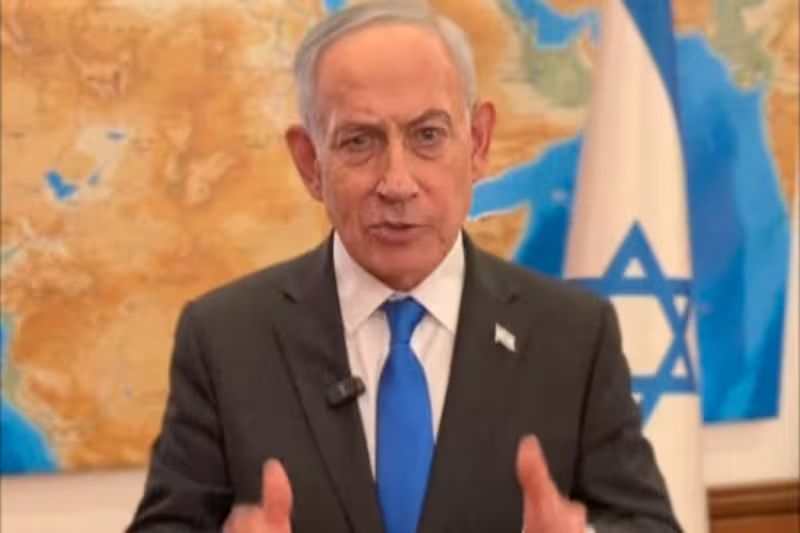
Prime Minister Benjamin Netanyahu declared on Monday that Israel was "at war with Hezbollah" and ordered an escalation that prompted the Israeli military to launch a new wave of strikes across Lebanon.
The Israel Defense Forces said it carried out strikes against Hezbollah positions in the Bekaa Valley in eastern Lebanon and in other parts of the country after Netanyahu said the military had been told to "deal them a crushing blow" and that "what this requires of us now is to increase the strikes, to increase the intensity." Netanyahu added on Telegram: "I have ordered an even greater acceleration of our operations" and said, "We will intensify our blows, increase our firepower, and we will crush them." He also said the offensive had already "eliminated over 600 terrorists."
Hezbollah said it retaliated with 22 drone and rocket attacks, saying its targets included Israeli soldiers, tanks, barracks and buildings. The group claimed responsibility for several attacks on Monday on three barracks and a military post in northern Israel, including at least four drone strikes on Shomera barracks and strikes on two other barracks and a post in Misgav Am.
The new exchange came as the Israeli air force carried out successive strikes in the Bekaa Valley on Monday evening and dozens of earlier strikes targeted towns and villages in southern Lebanon in the early hours, according to Lebanon's National News Agency. Israeli airstrikes also hit towns near the ancient city of Tyre after evacuation orders were issued for 10 villages in the south.
The human cost and displacement are already large. Lebanese authorities say Israeli strikes since early March have killed more than 3,100 people. In the period after the 45-day ceasefire agreement, heavy Israeli bombardment has killed more than 400 people, and more than one million people have been displaced inside Lebanon. On the Israeli side, 23 soldiers have been killed since hostilities began in early March; ten Israeli soldiers have been killed since the initial ceasefire, and the military reported a soldier was killed in southern Lebanon the previous day. One civilian contractor has also been killed.
The escalation reaches beyond battlefield statistics. Two far-right Israeli ministers, Bezalel Smotrich and Itamar Ben Gvir, called for expanding the campaign, including operations in Beirut. Smotrich wrote that "There is an urgent need to put an end to the threat posed by Hezbollah’s explosive drones," underscoring pressure inside Netanyahu's government to widen the scope of the fighting.
That pressure collides with the diplomatic framework that has so far tried to contain the conflict. Lebanon and Israel agreed earlier this month to extend a 45-day ceasefire that originally came into effect on 17 April after fighting erupted on 2 March. Yet the truce has been repeatedly violated: Israeli attacks have largely been confined to the south of Lebanon since the ceasefire agreement was signed on 16 April, but both sides report violations and retaliatory strikes.
The friction is clear. Netanyahu is framing the operations as a needed escalation to destroy Hezbollah's military capabilities — claiming hundreds of militants have been removed — while Lebanon reports thousands of civilian deaths and mass displacement. Hezbollah insists its attacks are retaliatory responses to what it calls violations of the ceasefire, and it has demonstrated an ability to strike Israeli military targets across the north.
Diplomacy is scheduled to resume next week, when officials from Lebanon and Israel are due to hold further negotiations in Washington. That meeting will be tested by an immediate operational reality: Israeli forces are intensifying strikes across multiple fronts as Hezbollah mounts drone and rocket attacks, and far-right ministers urge even broader strikes, raising the risk the ceasefire will collapse into wider war.
The single most consequential unanswered question now is whether the Washington talks can halt the military acceleration and turn a fragile, repeatedly violated truce back into a sustainable ceasefire before the violence expands beyond the current theatres and produces far greater civilian suffering.