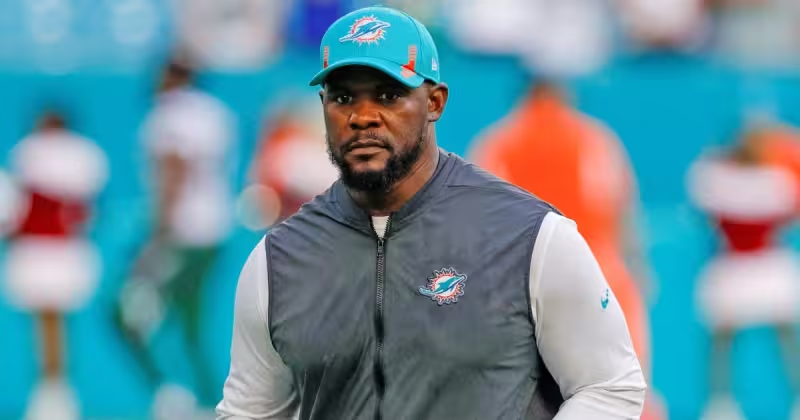
The Supreme Court on Tuesday refused the National Football League’s bid to move a Black coach’s racial discrimination claims into arbitration, leaving Brian Flores’ workplace-bias lawsuit to proceed in federal court.
The justices declined to hear an appeal filed by the league and three teams — the New York Giants, the Denver Broncos and the Houston Texans — preserving a lower court ruling that the NFL cannot force Flores to arbitrate through a process overseen by Commissioner Roger Goodell.
Flores, the former Miami Dolphins head coach and now the Minnesota Vikings’ defensive coordinator, filed the suit in 2022 after being fired despite leading Miami to winning records for two consecutive seasons. His complaint accuses the league of systematic discrimination against Black coaches and says he was asked to take “sham interviews” with the Giants and Broncos to satisfy the Rooney Rule.
The scale of the case has widened since the original filing. Former Arizona Cardinals head coach Steve Wilks and longtime assistant Ray Horton later joined Flores as plaintiffs, and in 2023 a New York-based federal judge ruled that the NFL and the Giants, Broncos and Texans must face some of Flores’ claims in court while sending other aspects to private arbitration.
On appeal the New York-based 2nd U.S. Circuit Court of Appeals in 2025 agreed that parts of the suit belonged in federal court and sharply criticized a provision in the NFL constitution that gave Goodell unilateral authority to compel arbitration. Judge Jose Cabranes wrote that the provision was “plainly unenforceable” and called it “an agreement for arbitration in name only.”
The litigation turns on whether disputes that Flores says amount to systemic bias can be funneled into an arbitration system controlled by the league’s chief executive. The Rooney Rule, adopted in 2003 in response to the historically low number of minority head coaches, requires that minorities be interviewed for coaching jobs — a policy central to Flores’ allegation that some interviews were perfunctory rather than genuine.
The NFL has denied claims of racial discrimination and pushed to resolve disputes through its internal arbitration process. The league told the Supreme Court it was entitled to have certain claims heard in arbitration rather than in open court. The 2nd Circuit and the New York judge reached the opposite conclusion for key parts of Flores’ case, setting up a direct conflict between the league’s preferred mechanism and the federal courts’ scrutiny.
The practical result of Tuesday’s refusal is straightforward: Flores’ federal-court claims remain alive. Some claims will still head to private arbitration, as earlier rulings bifurcated the suit, but the sections that federal judges found unsuited to arbitration will continue through the court system. The lawsuit seeks sweeping remedies — forcing changes to league hiring, incentives for teams to hire Black coaches and general managers, and requirements that teams explain hiring and firing decisions in writing.
That leaves a single, sharpened question: will a federal court order the structural reforms Flores asks for and reopen how the league and its teams hire and fire top personnel? The Supreme Court’s decision to step aside leaves that question in the hands of judges and, ultimately, the evidentiary process that will test whether the league’s practices amount to systemic discrimination.