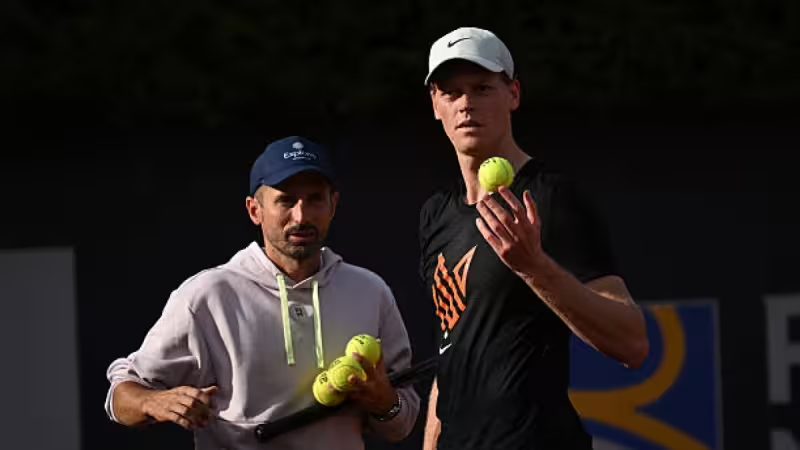
Jannik Sinner has won 29 consecutive matches and six consecutive ATP Masters 1000 titles, a run capped by a 6-4, 6-4 victory over Casper Ruud in the Italian Open final earlier in May.
The scale of the streak is immediate: 29 straight wins is the longest run in men’s tennis since Novak Djokovic won 43 consecutive matches in 2011, and Sinner’s ascent included reclaiming the ATP No. 1 ranking by mid-April. Courtside Advantage data over the past 52 weeks show Sinner winning 57 percent of baseline versus baseline points, narrowly ahead of Djokovic at 56.4 percent and Carlos Alcaraz at 55.8 percent — numbers that help explain why opponents keep coming up short against him.
Ruud, who lost to Sinner in Rome, described the pressure in plain terms: "You get no breathing room from any corner," he said. "Whether you’re playing the forehand crosscourt rally, the backhand crosscourt rally, you know that the ball will come at a high pace. So you know that if you’re not very precise with your own shots, he’s going to be there on top of you and punish you." That relentlessness — low percentages of balls into the middle strip, just 17 percent of forehands and 29 percent of backhands — forces opponents to be exact under fire.
That style of play is married to a coaching architecture that began in February 2022, when Simone Vagnozzi joined Sinner’s team. Darren Cahill arrived four months later. Vagnozzi says the first practice evaluation matched what they saw from outside: "We talked about how he played, how he could evolve. What he felt on the court was very similar to what I saw from the outside: incredible talent, but with significant margins in tactical vision and certain areas of his game. The beauty was that we saw his final evolution in the same way," he said.
Sinner has defined his approach in simpler terms. "I’m a player who plays a lot with my gut feeling," he said at the Italian Open. "If I feel a shot, I just go for it. I don’t second-guess." That instinctive aggression, combined with the baseline consistency reflected in the data, has produced the win streak and the six-event Masters run that now sits alongside an ATP Tour Finals title won earlier in the sequence.
Context sharpens why this matters now: Carlos Alcaraz won the Australian Open in January, and Novak Djokovic beat Sinner in the Australian Open semifinals, yet Sinner still rebuilt his season into a dominant stretch. The numbers and the trophies together make the case that this is not a hot week but a genuine shift in the pecking order of men’s tennis.
The friction in Sinner’s story is immediate. He missed most of February, March and April 2025 to serve an anti-doping suspension, and yet he had reclaimed No. 1 by mid-April and is now on a 29-match run. The sequence leaves a gap between absence and dominance that invites scrutiny: how did the ranking, rhythm and form realign so quickly after months away? The facts do not answer that; they only make the turnaround sharper.
What happens next is straightforward and unforgiving. Sinner’s current margin is thin in some technical senses — the baseline percentages show he edges his closest rivals rather than blowing them away — and opponents note he leaves them no room for error. The governing data, the coaching narrative Vagnozzi outlined, and Sinner’s own insistence on instinct combine into a single prediction: if he keeps playing the way he describes and his coaches keep shaping the tactical margins, the streak will force rivals to adapt fast or be punished.
In short, "sinner tennis" has become shorthand for a player who blends surgical placement with sudden, high-pace finishing shots. That formula, tested by an interrupted season and validated by six straight Masters and 29 wins, has shifted the debate from potential to production. Whether it becomes an era will depend on Sinner’s ability to stay precise under pressure — and on how quickly the rest catch up.