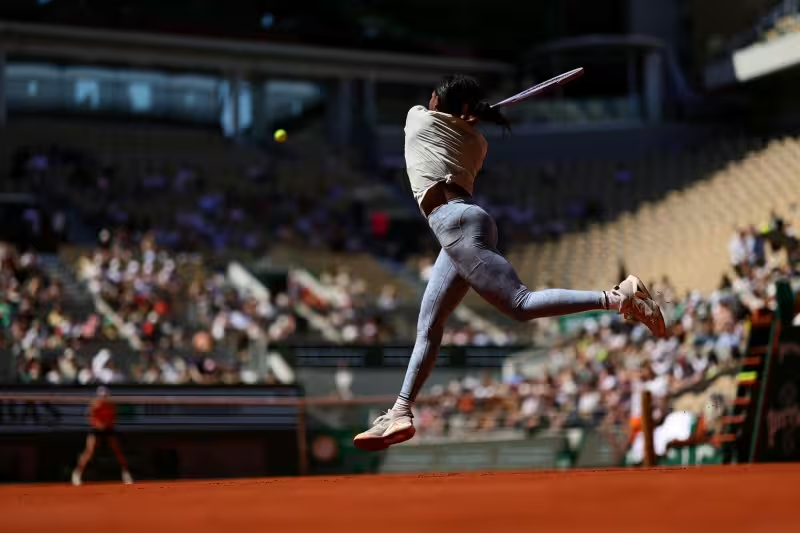
Coco Gauff will play Taylor Townsend in the first round of the French Open, the 22‑year‑old defending champion said at a Friday news conference as she closed preparation for Roland Garros.
Gauff arrives in Paris as the No. 4 seed, the reigning champion who won a dramatic comeback final last year, and with a Paris main‑draw record of 27‑5. Her off‑court profile has exploded — according to Sportico she earned $31 million last year from prize money and sponsorships — but this week the headlines are about how she walks onto the clay rather than how she markets herself.
The numbers underline why the opening match matters: Gauff is a two‑time Grand Slam champion with deep history in Paris, having been the youngest girls’ champion at Roland‑Garros since 1993 when she won the junior title in 2018 and lifting the women’s trophy in 2024 after beating Aryna Sabalenka. Yet since January she has reached two WTA 1000 finals and lost both in three hard‑fought sets, and she arrived in the French capital having weathered a volatile fortnight at lead‑up events.
Two Sundays ago in Rome, Gauff struck herself on the head with her racket in the Italian Open final against Elina Svitolina — an image that circulated widely. Asked about it at the news conference, she downplayed the moment: "It didn’t hurt," she said, explaining with a laugh that her big braids helped. The Italian Open finale capped a stretch that included, after her quarterfinal loss to Svitolina at the Australian Open in January, cameras catching Gauff smashing a racket underneath the stadium.
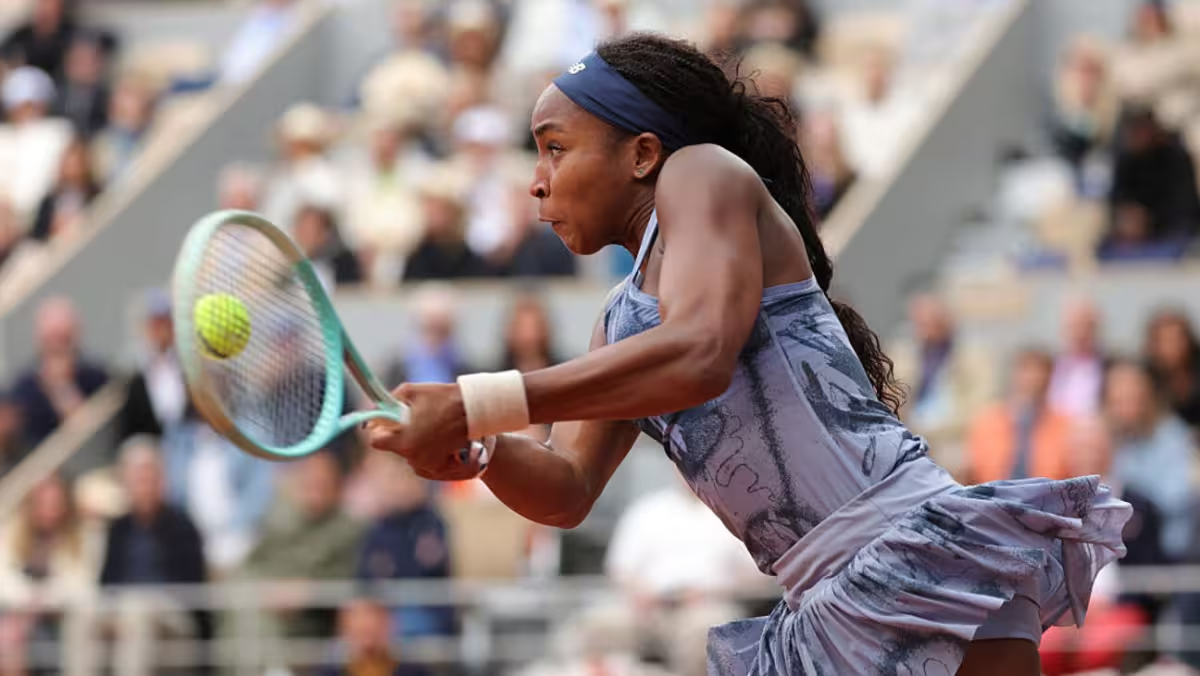
Those flashes of anger and the recent near‑misses are the tension running under Paris. Gauff herself framed it plainly: "When I’m playing the matches, I just want to win literally every point in the most perfect way. Obviously, it just doesn’t always happen for me like that all the time." Her pursuit of perfection has come with public breakdowns and private work: "I have a therapist that I have been going to for a long time, and also, just journaling," she said, describing how she has tried to manage the emotional swings.
Gauff tried to put the mixed build‑up into perspective. "I think I can see where I want to be, and I want to be there so bad. But I’m just trying now to focus on the process: The ups and downs of the journey of tennis," she told reporters. The process has included moments of gratitude and disorientation: "It's obviously different thinking about last year, but last year feels like ten years ago," she said. "Even if I'm not doing my best in the match, I know I can find that level just because of my history here, but it's also something I'm not thinking about entering the match."
Gauff also revisited how her earliest big Paris memory shaped her: she recalled 2022, when she reached the Roland‑Garros final and later said she "never want[ed] to lose a match like this again." "Honestly, I don't remember much. I just remember in the trophy ceremony, being, like, 'I never want to lose a match like this again,'" she said. Her stay in Paris has produced only a handful of losses by the notable hands of Martina Trevisan, Barbora Krejcikova and Iga Swiatek, underlining that clay is both familiar and unforgiving.
The match against Taylor Townsend will be the first, immediate test of whether Gauff’s recent work pays off. She has described the warm‑up events as a full rehearsal: "I think this week I experienced all the ups and downs that a tournament can bring you before a Grand Slam," she said. "I've been down, had the lead, lost the lead, I've been in the final, been down match point – I think I've experienced every scenario that can prepare me for Roland‑Garros."
What remains unresolved is whether experience and therapy will tame the urge for perfection and convert the near‑misses into another title defense. "Hopefully I can actually learn from each scenario and do better," Gauff said, and that hope now has a deadline: her opener against Taylor Townsend will decide how well that learning holds up under the pressure of Paris.