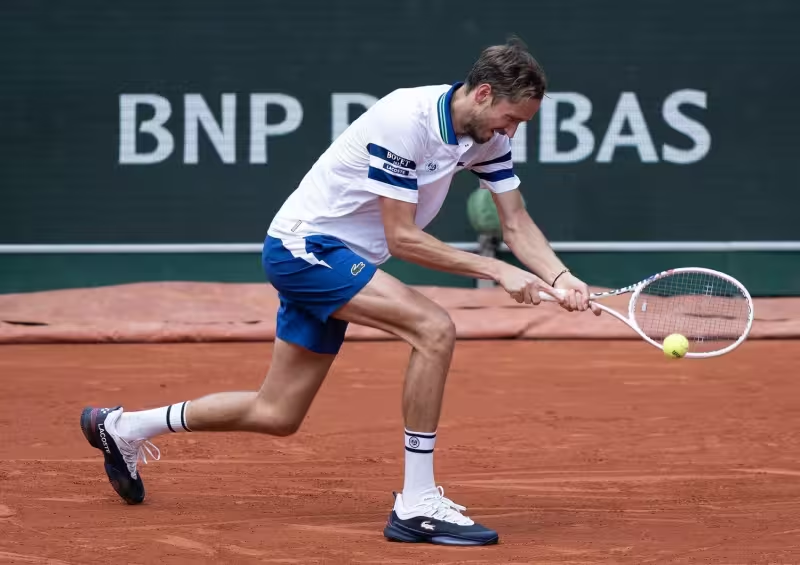
On Day 3, the first round of the French Open concludes with No. 6 seed Daniil Medvedev set to square off against Adam Walton.
The match is one item on a busy card: organizers list 20 more men’s matches taking the grounds of Roland Garros on Day 3. That volume of play closes out the opening round and concentrates attention on a handful of matchups framed as must-watch in predictions pieces published ahead of play.
The pairing — Daniil Medvedev versus Adam Walton — is carried inside a predictions article titled French Open Men's Predictions Including Medvedev vs Walton. The headline underlines the narrow focus of that piece: previews and scenario-building rather than reporting results.
That matters today because the first round is finishing. Day 3 is the day every outstanding opener must be decided. For a No. 6 seed like Medvedev, a first-round match on the final day of opening play is the last scheduled chance to set tempo for the fortnight; for Walton, the same deadline applies. The facts are simple: it is Day 3, there are 20 more men’s matches on the schedule, and this particular match appears inside a predictions-only article.



Those three facts do the work journalists usually use to explain significance: timing, scale and the players involved. The timing is concrete — Day 3 — and the scale is quantifiable — 20 more men’s matches. The players are named. The predictions headline frames readers’ expectations without offering a result: the piece speculates about possible outcomes but, as published, contains no match result for Medvedev vs. Walton.
That absence creates the story’s friction. A predictions article exists to anticipate what will happen, but on Day 3 the anticipated becomes immediate: a match will be played and a result will be entered into the tournament record. The piece that flagged Medvedev vs Walton gives readers possible directions for that result, yet the record remains empty until the match is completed. The contradiction is plain — a story built to forecast has no actual outcome to report at publication.
Readers should take away two clear things from that mismatch. First, the predictions package is a navigation tool for the day’s action, not a substitute for the match itself. Second, the timeline is immediate: the first round concludes on Day 3, so whatever the predictions say will be tested within hours or, at most, by the day’s end.
How this resolves is simple and consequential in practice. The match between Medvedev and Walton will produce a winner who advances from the first round or a loser who does not. That single result will alter the shape of the draw that predictions sought to outline. Until the final ball is struck, the predictions article stands as context — a set of informed possibilities — and the Roland Garros scoreboard will supply the fact.
For Adam Walton, the moment is immediate: he is the named player whose next act is to appear on court on Day 3. The predictions piece has placed Walton into the tournament narrative; the match itself will determine whether that placement will be reinforced or rewritten. That is the clearest question the day presents, and it is the question the reader watching Day 3 must expect to have answered before the sun sets on the opening round.