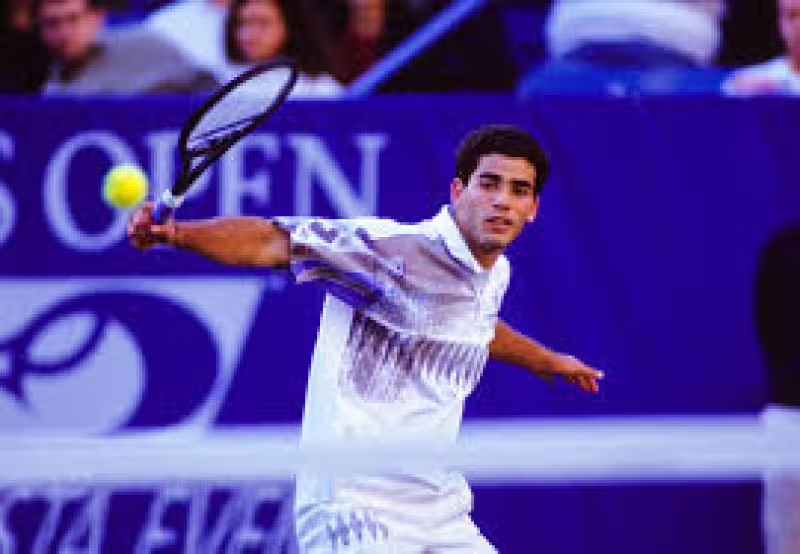
Carlos Alcaraz will miss Wimbledon after a right-wrist injury, the Spaniard announced on Instagram Tuesday, saying his recovery is progressing but that he is not yet ready to return to competition.
"My recovery is going well and I'm feeling much better, but unfortunately I'm still not ready to compete, which is why I have to withdraw from the grass-court swing at Queen's and Wimbledon," Alcaraz wrote, adding that "They are two truly special tournaments for me and I will miss them a lot." He said he would keep working on his comeback: "We'll keep working to come back as soon as possible."
The decision ends hopes of a title defense at a tournament where Alcaraz had twice before raised the trophy; he was the two-time defending champion at Wimbledon but lost in last year's final to Jannik Sinner. Alcaraz had been due to play at Queen's, where he is a two-time winner, before Wimbledon begins on 29 June.
The timing amplifies the sporting stakes. Alcaraz began the year by winning his first Australian Open title and, after that victory, became the youngest man to complete the career Grand Slam. His results have been dominant: he has won five of the past nine men's major singles titles. Even so, Jannik Sinner replaced Alcaraz as world number one last month, and the past nine majors have been divided between the two men.
The injury that forced this withdrawal first surfaced last month, when Alcaraz pulled out of the Barcelona Open after sustaining the right-wrist problem in the first round. He subsequently withdrew from the French Open to recover. Team and tournament announcements now list Alcaraz as expected to miss the entire grass-court season and the majority of the clay-court swing.
Wrist problems carry particular weight for tennis players because they are difficult to prevent and treat. "People often say tennis players who have prevented wrist injuries for their career thus far, they’re actually really lucky," Dr. Melissa Leber said, adding that "It has to do with your form and how you hit. But in general wrist injuries plague the majority of tennis players."
That medical reality sits uneasily with the optimistic tones in Alcaraz's message. Experts warn the wrong management of a wrist issue can derail a season. "Historically that seems to be the worst," Bill Mallon said, cautioning against underestimating the risk. Mallon added: "ACL (Anterior cruciate ligament) wouldn’t be good either, with all the twisting and turning, but I don’t hear of tennis players tearing their ACL very often."
Alcaraz's Instagram update is short on dates and long on intent: recovery is happening but racing back is not an option. For a player who opened the year by completing a rare personal milestone and whose rivalry with Sinner has defined men's majors recently, the enforced absence is both personal and competitive. He will miss two tournaments he called "truly special," and the men's draw at Wimbledon will proceed without the two-time defending champion.
Alcaraz's insistence that he will "keep working to come back as soon as possible" is the clear next step; how quickly that work will return him to Grand Slam contention is the single unanswered fact that now matters. Wimbledon starts on 29 June, and with Alcaraz sidelined, the season will advance without one of its most recent dominant figures.