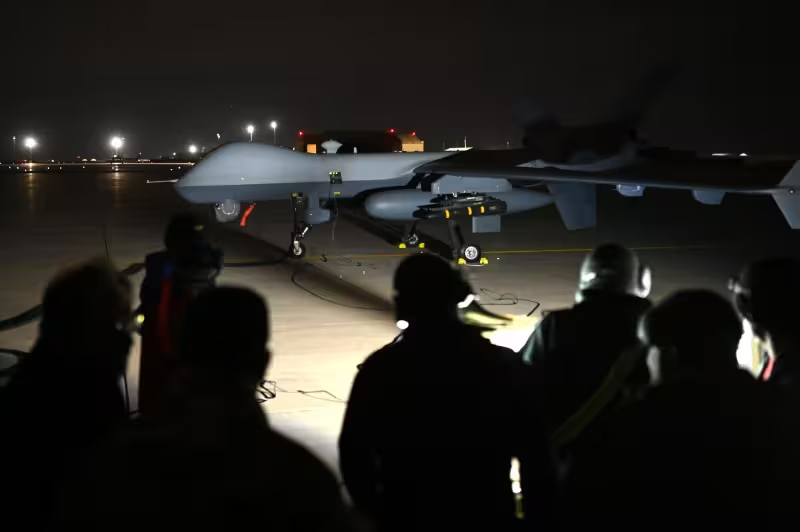
Gen. Kenneth S. Wilsbach told the House Armed Services Committee on May 20 that the MQ-9 Reaper was “perhaps the most valuable player” in Operation Epic Fury, a role he said the unmanned aircraft played again and again across the six-week air war with Iran.
Wilsbach said the Air Force had “made many, many strikes” with the MQ-9, and that “no other platform is even close to the MQ-9” in the number of strikes — a claim that lawmakers heard against a backdrop of more than 13,000 targets struck in Iran from late February to early April, including upward of 4,000 dynamic targets that appeared and were immediately engaged.
The weight of those figures is sharp. Reapers flew roughly a dozen orbits over Iran at a time to strike or to cue other platforms against mobile missile and drone launchers, aircraft and other fleeting targets. Nearly 30 MQ-9s were lost in operations against Iran, people familiar with the matter said, many to air defenses and some while parked on the ground; the fleet had fallen to roughly 135 aircraft after 24 losses cited by reporting, about 54 aircraft below the Air Force’s long-standing 189-aircraft floor.
Those losses did not end their use. Wilsbach and other officials said Reapers continued operations after the losses, conducting strikes and intelligence, surveillance and reconnaissance missions and operating around the Strait of Hormuz to enforce the U.S. military blockade of Iranian ports.
Context arrives after the combat praise: the Air Force has been planning to retire the MQ-9 even as it proved indispensable in Epic Fury. General Atomics shut down the MQ-9A production line in 2025 after the Air Force confirmed it would stop buying the platform. A current MQ-9 with a full sensor package can cost up to $50 million, a figure Maj. Gen. Christopher Niemi told a Senate subcommittee on May 12, raising the price stakes for any decision to rebuild the fleet.
The fiscal 2027 budget request the Air Force presented to Congress underlines the direction Washington is taking. The request includes the first procurement funding for Collaborative Combat Aircraft — $996.5 million for procurement and roughly $1.37 billion for research and development — and aims for more than 150 CCAs by the end of the Future Years Defense Program. The FY27 package also funds 38 F-35A fighters as part of an 85-aircraft joint buy and, according to Rep. John Garamendi, totals about $1.4 billion for CCAs, $7.4 billion for F-35s and $5 billion for the F-47.
That forward-leaning buying plan drew a sharp exchange on Capitol Hill. Secretary of the Air Force Troy Meink told lawmakers that unmanned aircraft will “play an increasingly important role as we build out into the future across the board.” Rep. Garamendi responded bluntly that “however, your budget doesn’t follow that passion,” and challenged the service to “put your money where your mouth is.” Meink answered “Absolutely.”
The tension is obvious and immediate: lawmakers and commanders are praising a platform the service is positioned to retire, even as combat operations exposed how reliant U.S. forces became on unmanned strike and ISR in practice. The Air Force declined to break down sorties or to give a precise number of MQ-9 strikes in Epic Fury, and U.S. Central Command has not detailed the specific roles Reapers played, leaving gaps between public praise and operational accounting.
Given the numbers on the table — more than 13,000 targets struck, nearly 30 MQ-9s lost, a fleet pushed below its 189-aircraft floor and a production line already shut — the next move is fiscal and strategic. The Air Force’s budget shift toward CCAs and continued investment in stealth fighters signals a long-term bet away from the MQ-9 as the centerpiece of future operations. Unless Congress chooses to reverse that path with emergency procurement or replenishment funding, the Reaper’s wartime prominence may be remembered as a capability gap the service opted not to close.