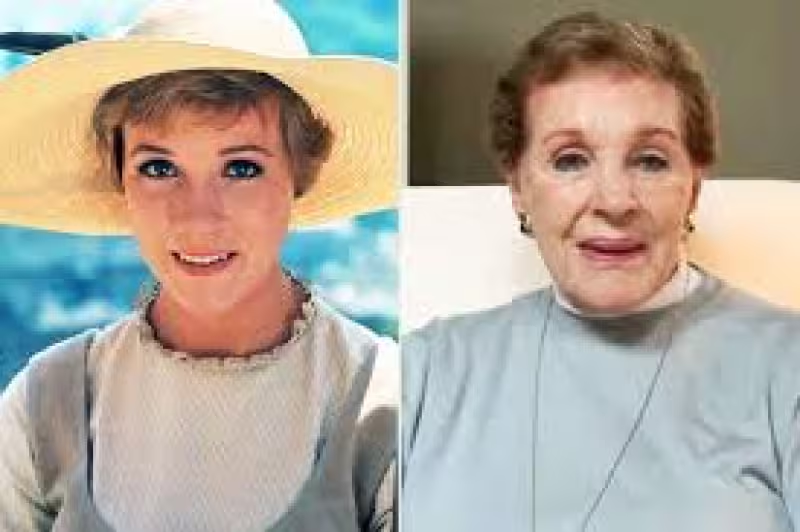
Julie Andrews made a rare public appearance on Sunday, May 25, when she appeared in a pre-recorded video to open the seventh World Parkinson’s Congress in Phoenix, Arizona.
Andrews began her short address with a formal greeting: "Good evening, everyone, I’m Julie Andrews and I’m pleased to welcome you to the seventh World Parkinson’s Congress." The 90-year-old then tied her message directly to the event’s mission, saying, "Your participation is invaluable as we seek to find a cure to this terrible disease."
The numbers and the setting underline why organizers highlighted her appearance: the gathering in Phoenix is the seventh iteration of an international forum dedicated to Parkinson’s, and Andrews offered a visible, high-profile endorsement for one of the conference’s signature efforts, the Red Thread Project.
She framed her remarks personally and plainly. "I know well how devastating it can be," Andrews said, and she closed with a rallying image that the project had adopted: "May we all become a beacon of light to stop it in its tracks. Count me in as a red thread. Thank you." The Red Thread Project seeks to connect people impacted by Parkinson’s by linking them symbolically with a red thread.
The appearance mattered because Andrews has spent much of her later life away from public stages. Before May 25, 2025, she had remained largely out of the public eye; the pre-recorded format let her participate without traveling to Phoenix while still lending her name and voice to the cause.
That choice exposes the tension between presence and influence. Andrews did not join delegates in person, and the video was brief, but the endorsement carried weight because she has long been an advocate for Parkinson’s research and because she remains widely recognizable: Andrews provided the voice of narrator Lady Whistledown on all four seasons of Bridgerton, a role that keeps her connected to a new generation of viewers.
The event and Andrews’s remarks also clarified one other point the organizers emphasized: Andrews does not personally suffer from Parkinson’s disease. Her participation was offered as advocacy, not as testimony, and the wording of her message—"Your participation is invaluable as we seek to find a cure to this terrible disease"—placed the burden squarely on research and community action.
What happens next is practical and immediate for the congress and the Red Thread Project. Andrews’s recorded endorsement will be part of the conference record and promotional reach; organizers can and will point to her support as they build momentum for research funding and outreach. For the movement she named, the likely consequence is wider visibility and a symbolic boost to a campaign designed to knit together those affected by Parkinson’s.
Andrews’s brief return to the public sphere answered the most pressing question her appearance raised: she was not speaking as a patient but as a longtime advocate who is lending the authority of her name and voice to a global effort. That decision — a short, deliberate message from a figure who has otherwise kept to the margins of public life — will matter most in the weeks after the congress, when organizers measure whether the Red Thread Project reached new communities because one of its threads came from Julie Andrews.