
Andrew Scott stood with Brendan Fraser and director Anthony Maras in Los Angeles on Tuesday, May 12, 2026, to promote Pressure, the new film that dramatizes the weather forecasts behind the D-Day landings.
The appearance put the film's human stakes on display: Pressure focuses on the forecasts for June 5 and 6, 1944, and Scott appears in the film as James Stagg, Britain's chief meteorological officer, whose forecasts became central to the Allied timetable. Focus Features has released images showing Fraser and Scott in a scene, and separate images of Scott and Maras on the set, underscoring how the production frames a technical decision as a matter of life and death.
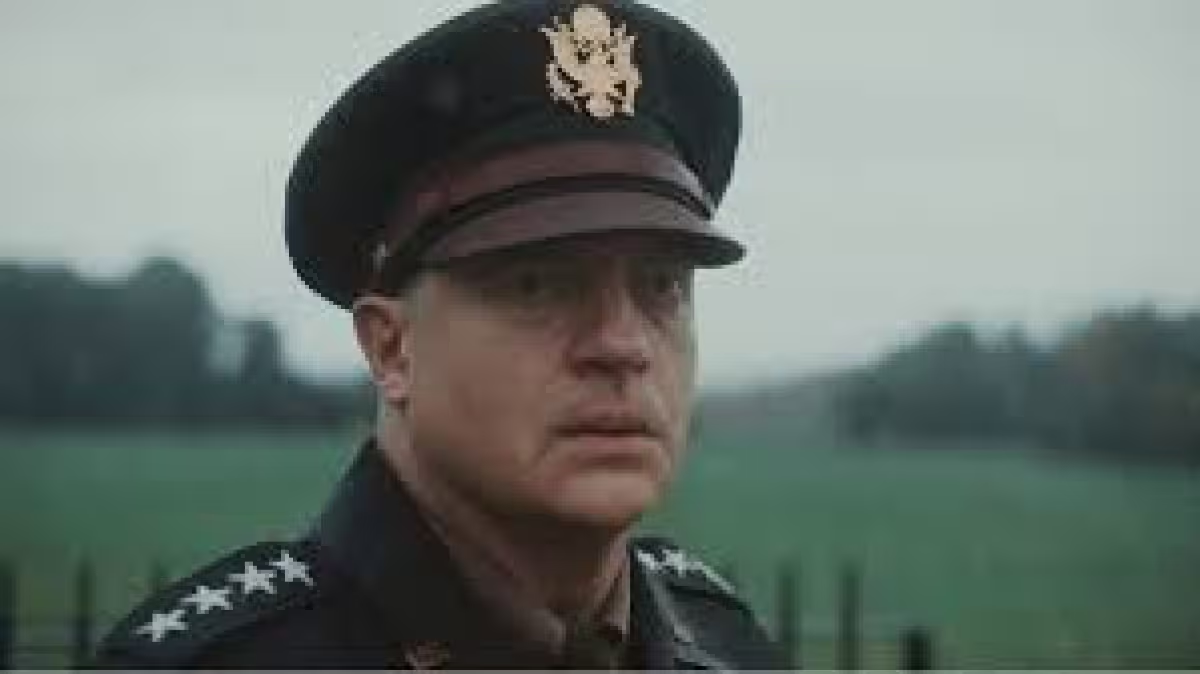
Brendan Fraser, who plays Gen. Dwight D. Eisenhower, said he prepared for the role through careful research, telling reporters he listened to podcasts until his ears hurt and read relentlessly about Eisenhower to absorb the general's character. Fraser said he came away convinced Eisenhower was widely admired in his day, an able diplomat who listened to people rather than simply hearing them. He added that Eisenhower did not pretend to know what he did not and left technical judgment to experts while caring deeply for the troops under his command.
Pressure opens in theaters on May 29 and, by narrowing its frame to those forecasts, the film promises to make meteorology the pivot on which one of the 20th century's largest military operations turned. The Deseret News has described the film as highlighting the roughly 72 hours leading up to the invasion, a tight window in which forecasts, tides and timing all had to align.

The choice to dramatize that 72-hour stretch creates an intrinsic tension: commanders needed decisive orders while the weather men were dealing with uncertainty. The film's subject matter gains urgency from wartime precedent—six weeks before D-Day, a live-ammunition rehearsal known as Exercise Tiger inflicted heavy losses—which the film's framing invokes to show how costly a wrong call could be.
For Scott, portraying Stagg means embodying the expert whose technical judgment helped shape Eisenhower's decision. The facts the film foregrounds are simple and sharp: the weather on June 5 and 6, 1944, and the forecasts that guided the invasion timetable. Maras, who co-wrote and directed Pressure, has centered his film on that intersection of science and command, using the relationship between Stagg and Eisenhower to dramatize how leaders relied on specialists.
The tension at the heart of the story is not cinematic invention so much as historical compression. Turning days of complex forecasting into a feature-length drama necessarily reduces nuance, but the cast and the production material released by Focus Features make clear which choices the film emphasizes—the human side of technical expertise and the weight a few days can carry in wartime.
Audiences will see how those choices play out when Pressure opens on May 29. If the film succeeds, it will do so by showing that decisions made under weather's uncertainty were as decisive as any battle plan—a point Scott's portrayal of James Stagg aims to make visible on screen.