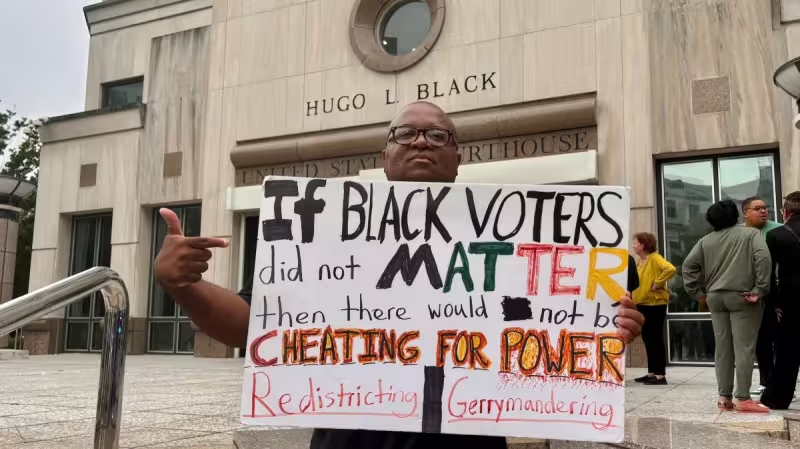
A federal panel on Tuesday rejected Alabama’s bid to use a new voting map for the November midterm elections, ruling that the districts discriminated against Black people and could not be put in place so close to an election. Alabama’s attorney general said he would immediately appeal to the Supreme Court.
The three-judge panel in Birmingham issued a 79-page ruling that blocks the map from taking effect now and could undercut a plan that would likely leave Democrats with only one majority-Black district. Gov. Kay Ivey had already set special primaries in August in four House districts that would be affected by the state’s new congressional map, adding another layer of uncertainty for voters and campaigns trying to prepare for November.
The judges said they had “no doubt” that Alabama’s map intentionally discriminated based on race in violation of the Constitution. The panel, which included Judge Stanley Marcus, Judge Anna M. Manasco and Judge Terry F. Moorer, said it was reviewing the case through the lens of the Supreme Court’s updated Voting Rights Act ruling from last month, but still concluded it could not require Alabamians to vote under a districting plan tainted by intentional race-based discrimination. They also wrote that they were “painfully aware of the gravity of our ruling” and that they “do not find the issue particularly complex or close.”
The decision lands after a turbulent run of redistricting in Alabama. In 2023, the Supreme Court ordered the state to create a new majority-Black congressional district in Allen v. Milligan. Last year, the same three-judge panel concluded after a full trial that Alabama had discriminated against Black voters by refusing to draw such a district. Then, last month, the Supreme Court in Louisiana v. Callais narrowed the Voting Rights Act standard and allowed Alabama to use a map with only one majority-Black district for November’s midterms.
That is the tension now at the center of the case: the Supreme Court’s new direction opened the door for Alabama’s map, but the Birmingham court said the map itself still cannot stand if it was drawn with intentional racial discrimination. The judges said the updated standard did not change their conclusion. Marshall called the ruling “disappointed, but not at all surprised,” and said, “in my mind, it is not a matter of whether we win this case, only when.”
The appeal now puts the case on a fast track to the Supreme Court, which would turn Alabama into the first major test of its new standard for challenging congressional maps if it agrees to hear the dispute. For now, the state’s new map is blocked, the special primaries remain in place, and the next decisive move belongs to the justices in Washington.