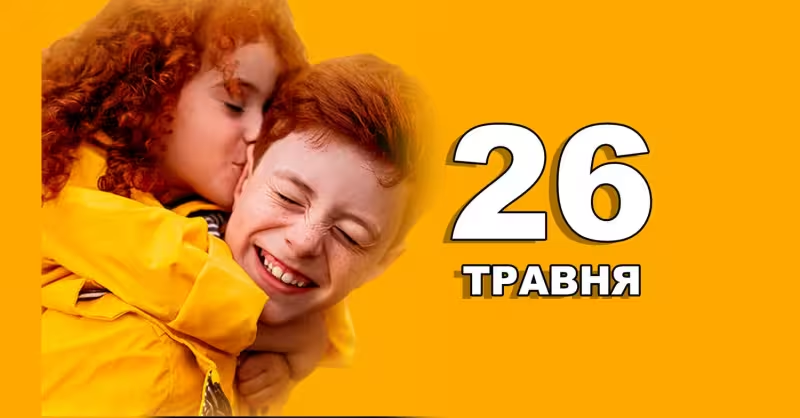
May 26 marks International Redhead Day, widely known as World Redhead Day, and the date has become a focus of gatherings, festivals and online tributes for people with fiery red hair. Bart Rovenhorst is one person whose small search for a red‑haired model turned unexpectedly public: he expected a few people to answer a casting call, and over 150 redheads showed up — a moment that helped seed what is now a large Redhead Days festival.
The numbers underline why the day matters: red hair is rare, present in only about 1 to 2 percent of the world’s population, yet every year on May 26 social media is flooded with photos of redheads from around the world and themed gatherings draw thousands. The holiday has particular traction in the Netherlands, Ireland, the United Kingdom and the United States, and it is gradually gaining popularity in Ukraine. For many participants the day is not just a photo opportunity but a public pushback against stereotypes, jokes and bullying directed at redheads.
Those stereotypes have deep roots. In the Middle Ages, people with red hair were sometimes considered strange or linked to the supernatural, and redheads have often been the target of prejudice. The modern holiday emerged as a response to that stigma: one version of its history says activists in the Netherlands in the mid‑2000s started Redhead Day to support people who faced discrimination and to draw attention to the rarity of the hair color. Another version ties the celebration to Rovenhorst’s casting call and the large turnout that grew into the Redhead Days festival, which now brings together thousands from different countries every year.
Biology underpins some of the attention. Red hair results from a mutation in the MC1R gene, and scientists say redheads can react differently to pain, to the sun and to certain medications. The novelty of the trait, combined with its uneven geographic distribution — the highest concentration of redheads lives in Ireland and Scotland — helps explain both the fascination and the focused celebrations in parts of Europe and North America.
The holiday, however, carries a tension built into its success: World Redhead Day has no official status even as online participation and real‑world festivals have made it highly visible. Social media users mark May 26 by sharing old photos, joking about fiery temperaments and sending greetings to red‑haired friends, while physical events range from themed photo shoots to multi‑day meetups. That popularity has turned an unofficial observance into a recurring international moment, but the day’s origins remain unsettled between grassroots activism and the artist’s casting call that surprised Rovenhorst.
Another friction is cultural memory. The same traits that once invited suspicion — hair that marked someone as different in medieval Europe — are now celebrated in public squares and on feeds. Organizers and attendees frame the day around individuality, beauty and self‑acceptance, a deliberate counter to the jokes and prejudice that helped create the holiday in the first place.
Rovenhorst’s casting call, which began as a search for a sitter, and the activists’ mid‑2000s efforts point to the same outcome: a growing, unofficial day of recognition on May 26. Today, the combination of thousands gathering at Redhead Days festivals and the annual social media flood has given World Redhead Day a clear function — it is a global moment to talk about identity and to push back against old stereotypes. That transformation, from a handful of respondents to international celebrations, is the clearest proof that a rare gene and a long history of prejudice can be reframed into a loud, collective insistence on dignity and visibility.