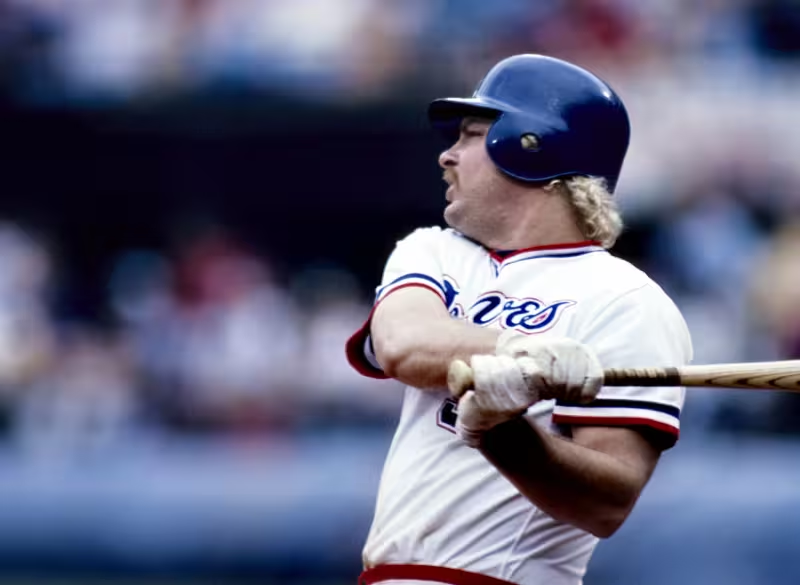
Bob Horner, the Atlanta power hitter who entered the big leagues as baseball’s most immediate prospect, has died at 68, the Atlanta Braves announced on May 26.
Horner finished his major‑league career with 218 home runs, 685 RBIs and a.277 batting average in 1,020 games. He was the National League Rookie of the Year in 1978 and an NL All‑Star in 1982, and he remains the only Atlanta player to hit four home runs in a single game, doing so against the Montreal Expos in 1986.
Horner’s resume read like a string of firsts. He was the first overall pick in the 1978 draft and the first Braves draftee to skip the minor leagues and debut directly in the majors. For nearly a decade he formed one of the game’s most feared power duos alongside Dale Murphy, a partnership that defined the Braves’ lineup from 1978 to 1986.

The arc of Horner’s career also contained abrupt turns. After nine seasons in Atlanta, he spent the 1987 season with Japan’s Yakult Swallows, hitting 31 home runs — fifth in NPB that year — before returning to the United States and finishing his career with the St. Louis Cardinals in 1988. The detour to Japan — brief but productive — came just after some of his most memorable moments in Atlanta, including the four‑homer night in 1986.
Those milestones mattered to teammates and fans because they were concrete and rare: Rookie of the Year honors in 1978, an All‑Star berth in 1982, and a franchise‑first single‑game display of power. The Braves noted that Horner’s career was defined by being first, from draft pick to debut to the pages of the team record book.
For all the highlights, Horner’s path was not a long, uninterrupted run at the game’s summit; it was a burst of elite production that included international play and a late‑career switch of uniforms. He left Atlanta after the 1986 season, produced a big year in Japan, and wrapped up in St. Louis two years later — a compact major‑league story that still contained signature moments few players ever match.
The Braves extended their sincere sympathies to his wife, Chris, to his two sons, Tyler and Trent, and to his many friends and fans across the game. Horner’s combination of early arrival, power production and headline moments makes his place in franchise history unmistakable.