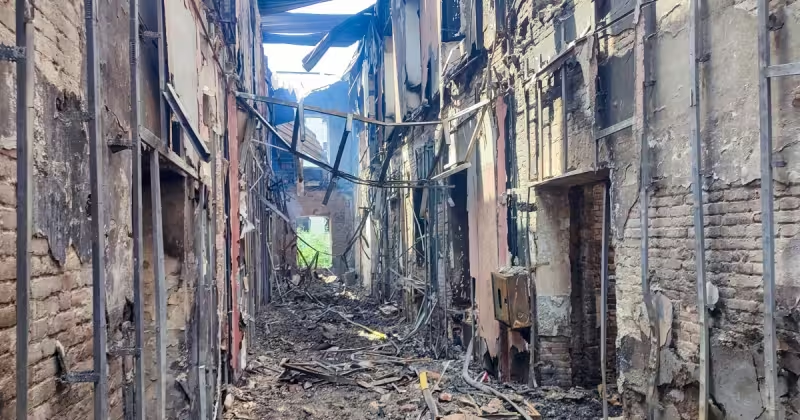
Diana Shovkun, 19, was shown injured on Russian state television Saturday after a drone strike on a student dorm in the Russian-controlled town of Starobilsk, where Moscow and Kyiv traded competing claims over who carried out the attack.
Russian authorities said the strike killed 16 people, citing the emergency ministry, and that most of the victims were young women; the state news agency RIA reported the rising death toll while regional leader Leonid Pasechnik published a preliminary list with details of 11 victims, most of them 19-year-old women. The reported a higher figure — 18 dead and 42 injured — and said three people were believed to remain trapped under the rubble, while Russian officials said five remained trapped in one report.
Russia said the attack hit the student dorm in Starobilsk in three waves using 16 drones. A Russian resident described a sequence in which rockets struck a former military base and drones then hit the dormitory, igniting fires that reduced parts of the building to rubble.
President Vladimir Putin ordered the Russian military to draw up proposals for retaliation on Friday, a move that came as Moscow called an emergency meeting of the U.N. Security Council to accuse Ukraine of war crimes over the incident. Putin insisted there were no military, intelligence or related facilities in the vicinity of the strike and said there was no basis to argue Russian air defences or electronic warfare caused munitions to hit the building.
Kyiv has denied responsibility. Ukraine's military told the U.N. Security Council that Russia's claim was baseless and had not been independently verified; late on Friday it said the overnight strike in Starobilsk had targeted what it described as the Rubicon group's headquarters, an elite drone command unit operating in the area, and added that Ukrainian forces act in line with the laws and customs of war.

The incident has produced immediate fallout inside Russia. Early on Saturday, officials reported that falling debris from drones had triggered a fire at an oil depot in the Black Sea port of Novorossiysk, injuring two people. The general headquarters of the southern Krasnodar region said fragments had fallen on a fuel terminal and that several technical administrative buildings caught fire; officials also reported drone fragments had damaged private homes in nearby Anapa.
The figures and the competing narratives deepen a familiar wartime contradiction: Moscow says civilians were deliberately targeted and has presented images and lists of victims; Kyiv denies the attack on the dorm and says it struck a military drone command post. Independent verification of the site and the sequence of strikes has not been provided in the accounts presented so far.
At stake is more than casualty counting. Russia’s formal accusation of war crimes at the U.N. Security Council and Mr. Putin’s order for retaliation proposals put this single strike squarely into the broader pattern of cross-border attacks and counterattacks seen in recent months, including Ukrainian strikes on facilities inside Russian-held territory and Russian strikes on civilian infrastructure in Ukraine.
Thursday’s related developments underline the wider context: Ukraine’s president said an attack had hit the FSB’s headquarters in the Moscow-held Kherson region earlier in the week and that about 100 Russian occupiers were killed or injured — a claim Moscow disputes. Both sides have repeatedly accused the other of targeting civilians, and the sequence of strikes has blurred front lines and civilian-military distinctions in areas away from active combat.
The most consequential immediate fact is procedural but stark: Mr. Putin has asked the military for concrete retaliation options. Given the scale of the reported casualties, the presence of wounded students and the conflicting operational claims by Kyiv and Moscow, the request for retaliatory proposals makes a wider, sharper response — and a risk of escalation — the most likely next chapter in this particular confrontation.