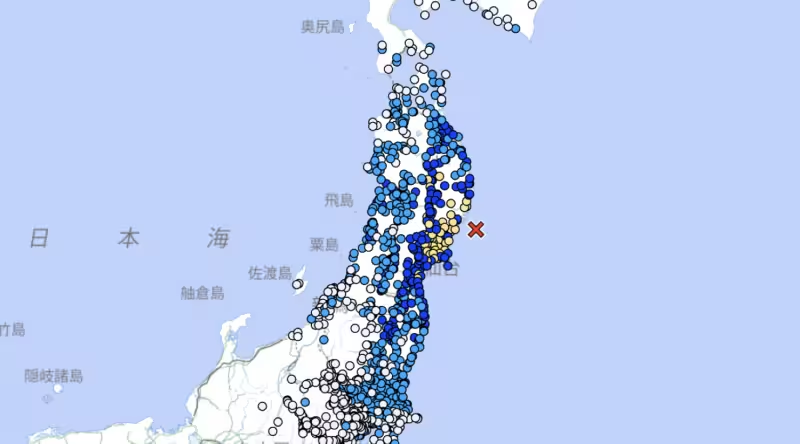
A magnitude 6.3 earthquake struck off the coast of Miyagi Prefecture at 8:22 p.m. Friday, the Japan Meteorological Agency said, rattling the Tohoku region but prompting no tsunami threat.
The agency said the tremor originated at a relatively large depth of around 50 kilometers. Japanese authorities issued emergency warnings to people in five prefectures and rated the quake a five on their 1–7 intensity scale; several cities in Miyagi — Tome, Osaki and Ishinomaki — recorded a lower 5, while areas across Miyagi and Iwate registered a 4.
The U.S. Geological Survey placed the epicentre about 50 km east of the town of Ofunato and revised its magnitude estimate to 6.7, up from an initial 6.6. Different agency numbers left multiple magnitude figures circulating in the hours after the event, at times summed up online under tags such as "5.9 earthquake" as officials and monitoring services reconciled readings.
The quake was the largest to hit the Tohoku region since a magnitude 7.7 temblor on April 20. That earlier April 20 event had prompted a tsunami alert and a rare special advisory warning of an increased risk of major earthquakes; it injured at least 33 people, sent waves up to 70 cm into several coastal communities and led to evacuation advisories for more than 170,000 people before those advisories were lifted.
Friday evening’s temblor caused immediate disruption to rail services. The Tohoku Shinkansen Line was temporarily suspended between Tokyo and Shin-Aomori stations, and some trains on the Yamagata Shinkansen remained suspended. Operators expected service on the affected Tohoku runs to resume by around 10:40 p.m.
There were no immediate reports of injuries or damage following Friday’s quake, and meteorological authorities emphasized there was no tsunami threat linked to the event. Still, the strength and timing of the shaking — coming just weeks after the April 20 shock — underscored why emergency warnings were issued across five prefectures that evening.
The most consequential friction in the aftermath was not physical damage but measurement: Japanese and U.S. agencies reported different magnitudes and described the quake as both relatively deep and strong, a combination that can complicate rapid public guidance and risk assessments. That discrepancy has been a recurring feature of the recent cluster of temblors affecting northeastern and northern Japan.
With officials already warning of an elevated risk after the April 20 earthquake, the key question now is whether the sequence will settle into smaller aftershocks or produce another larger event. For residents and transport operators, the immediate concern will be how quickly monitoring agencies can converge on consistent readings and restore disrupted services while keeping emergency alerts calibrated to real-time conditions.