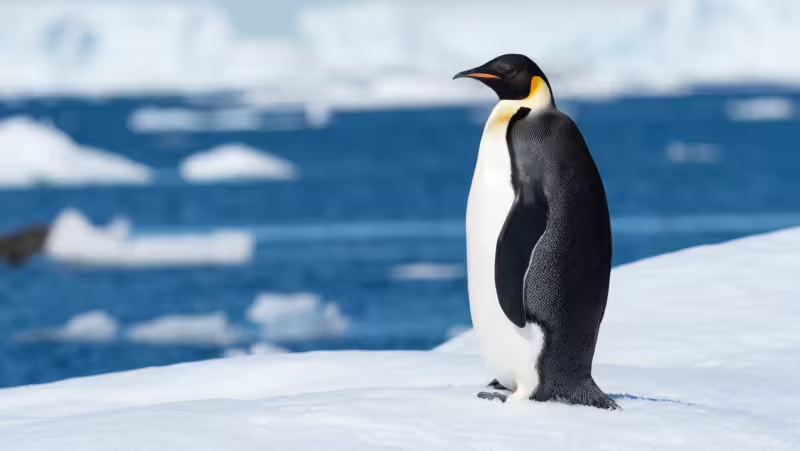
The 48th Antarctic Treaty Consultative Meeting ended in Hiroshima this week without granting the emperor penguin legal protection, a result conservationists said will leave the species exposed while its habitat disappears — a development that drew sharp criticism from Rod Downie.
Earlier this year the IUCN elevated the emperor penguin to Endangered status; scientists at the meeting warned that sea ice loss — which the Scientific Committee on Antarctic Research described as exceptional — removes critical breeding habitat and, under business-as-usual emissions, models project functional extinction of the species by 2100.
The proposal to designate the emperor penguin as a Specially Protected Species did not pass. It was opposed by only a small minority of the Parties present, delegates said, yet that minority was enough to block a measure conservationists argued would have triggered a coordinated framework of conservation measures across the continent.
"The barometer is flashing red, yet critical protections are still being stymied by a small number of Parties," Rod Downie said after the meeting, which concluded with Parties reaffirming protection of the species as a priority even as they rejected the formal designation.
The Scientific Committee on Antarctic Research told delegates that changes across Antarctic systems are abrupt and accelerating, and that sea ice loss is exceptional. The meeting also heard warnings about the consequences of Antarctic ice sheet destabilisation for sea levels — a reminder that the region’s ecological collapse would have global costs far beyond antarctica’s coasts.
Visitor numbers to Antarctica have surged in recent years, and the meeting moved negotiations toward a regulatory framework for tourism but stopped short of anything legally enforceable. Voluntary guidelines remain the primary tool governing Antarctic tourism, a fact that prompted blunt words from diplomatic voices at the conference.
Ricardo Roura said: "We cannot continue relying on largely voluntary guidelines while commercial tourism operations expand rapidly across the continent." He added: "Developing a framework is a start, but the ATCM must urgently transform these discussions into mandatory, legally binding regulations before tourism growth outpaces our ability to protect the environment – and its intrinsic values recognised under the Protocol."
Those words captured the tension that ran through negotiations. Conservation groups argued science is moving faster than diplomacy: the IUCN’s elevation of the emperor penguin to Endangered status and SCAR’s assessment of rapid Antarctic change contrasted with a treaty process that, critics said, still defaults to voluntary measures and incrementalism.
Claire Christian put that gap plainly: "The pace of diplomatic decision-making remains dangerously slow compared to the rapid climate and biodiversity crisis unfolding in Antarctica." Her comment underscored a recurring friction at the meeting — Parties agree on the threat but remain divided over how far to formalize protections in legally binding rules.
Supporters of the Specially Protected Species proposal argued it would have obligated signatories to a coordinated set of conservation actions and monitoring, creating a mechanism to manage risks to the emperor penguin’s breeding sites as sea ice patterns shift. Opponents, in the small minority that blocked the proposal, said they were not prepared to accept the specific measures or language proposed at this session.
The ATCM did advance talks on tourism regulation, producing language that moves toward a framework for oversight but does not create enforceable obligations. That limited progress leaves voluntary guidelines as the primary governance tool at a moment when commercial interest in Antarctica is increasing and the habitat on which key species depend is changing faster than historical precedent.
Delegates set their sights on next year’s meeting in the Republic of Korea as the next chance to turn pledges into policy. "The endangered emperor penguin is a stark reminder of how the climate and nature crises are intertwined. We must look now to next year’s meeting in the Republic of Korea to deliver meaningful action to protect this icon on ice," Rod Downie said, framing the choice plainly: more diplomatic delay risks letting an emblem of antarctica slip toward extinction while regulators and tour operators scramble to catch up.