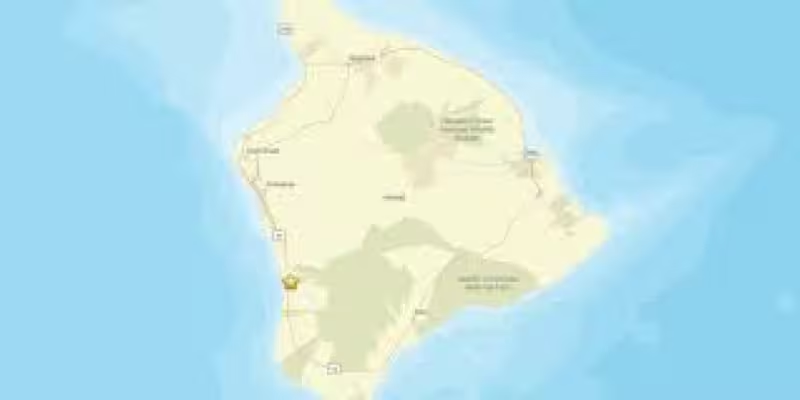
A magnitude 6.0 earthquake struck about seven miles east-southeast of Honaunau in the South Kona area of Hawaii Island at 9:46 p.m., sending strong shaking across the state but, officials said, producing no tsunami.
The U.S. Geological Survey placed the quake’s epicenter roughly 3.7 miles east-southeast of the Honaunau‑Napoopoo area along the western flank of Mauna Loa and pegged its depth at about 14 miles. The tremor was first listed as magnitude 5.9 and later upgraded to magnitude 6.0.
The Pacific Tsunami Warning Center said no tsunami was generated by the earthquake, and no tsunami warning was issued. Six minutes after the main shock a weaker magnitude 3.2 temblor struck just to the northwest of the first event at a depth of about 13 miles.
Reports of strong shaking came from across multiple islands. On Hawaii Island the quake was centered about eight miles south of Honaunau‑Napoopoo and about 22 miles south‑southeast of Kailua‑Kona. Residents reported feeling the jolt across the state, with messages and calls coming from Maui and Oahu and as far away as Omao on the Big Island and Hanalei on Kauai.
On Oahu, residents reported strong shaking in Kailua, Ewa Beach and Kapolei. Media outlets on Maui said they received calls from people in Makawao and Wailuku. The USGS "Did you feel it?" online survey logged dozens of immediate responses, including reports from Lahaina on Maui and Mililani on Oahu.
The sequence — a shallow, moderate main shock followed quickly by a smaller event nearby — fits the pattern of a primary quake and immediate aftershock. The shallow depth and the location on Mauna Loa’s western flank explain why the tremor was widely felt despite the moderate magnitude: energy released near the surface transmits more strongly to nearby communities than deeper earthquakes.
Context for the island chain is simple and relevant: Mauna Loa is an active volcanic edifice and its flanks experience frequent seismicity. The western side of the mountain, where this quake struck, lies near coastal communities and tourist areas; that physical proximity is why a 6.0 quake on Hawaii Island was felt on neighboring islands, including Maui and Oahu.
Tension in the immediate accounting comes from early measurements and public reaction. The USGS initially labeled the event magnitude 5.9 before upgrading it to 6.0, and local reports of the epicenter’s distance from community centers vary slightly in early dispatches. Those small discrepancies matter for residents trying to reconcile alerts, felt reports and safety guidance in the first anxious minutes after a strong jolt.
For now, the most consequential fact is the absence of a tsunami: the Pacific Tsunami Warning Center’s assessment removed the immediate risk to low‑lying coastal areas. But the aftershock sequence and the shallow location mean authorities and residents should expect additional smaller tremors in the hours to come and remain alert for official advisories.
Data collected in the next day — more felt reports, aftershock locations and any updates from seismic agencies — will determine whether this episode remains a contained, moderate event or becomes part of a longer local sequence. The earthquake left no confirmed tsunami and no immediate change in hazard messages, but it underscored how a single shallow quake on Mauna Loa’s flank can reverberate across the islands and prompt rapid public reaction.