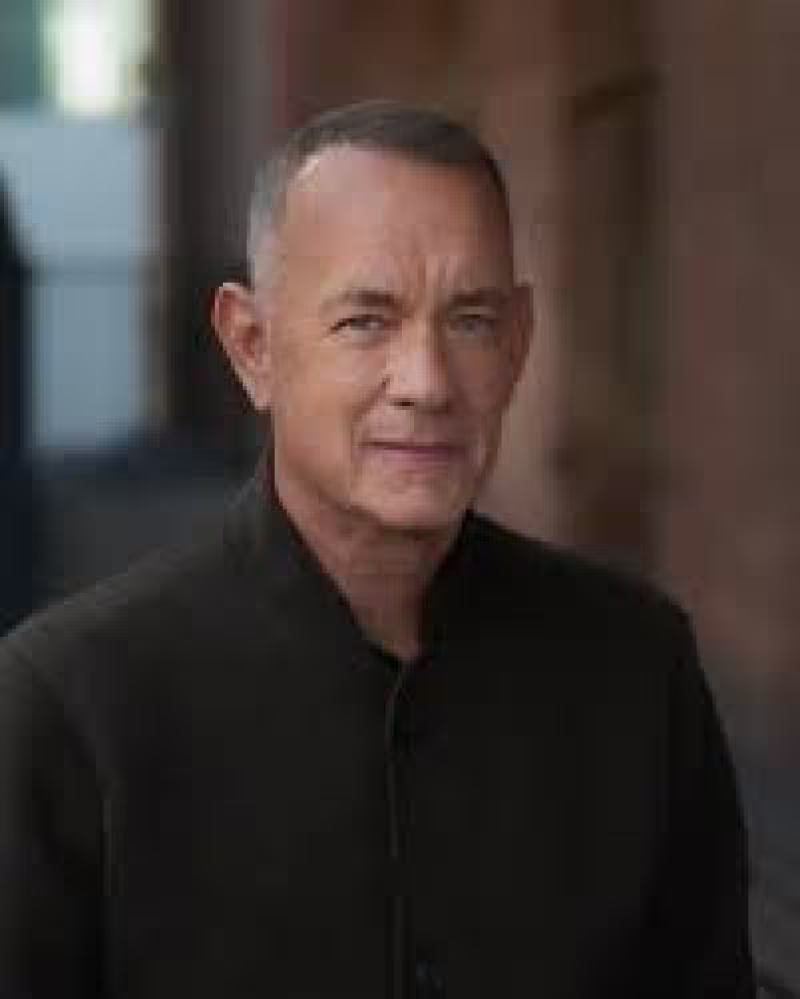
Tom Hanks says he keeps returning to World War II because the story is not only about the 1930s and 1940s, but about the choices people face right now — a theme he laid out ahead of the Memorial Day premiere of a 20-part documentary series on the History Channel.
Hanks told The Hollywood Reporter that he had been wrestling with his fascination with World War II and asking himself, in private moments, why he repeatedly turns to the period for what he called “poetry and solace and enlightenment.” The new series, World War II with Tom Hanks, covers every major theater of the war from 1939 through 1945, runs 20 episodes, and was created in collaboration with the National WWII Museum.
The scale is part of the point. has described the series as one of the largest documentaries in human history, noting that Hanks narrates and appears on camera at the beginning and end of each installment and that the show relies on archive footage alongside commentary from academics and popular historians. Hanks and his collaborators say the project aims to be sweeping: chronicle after chronicle, theatre after theatre, across the years from the storm that began in Europe in September 1939 through the war’s end in 1945.
Hanks framed his ongoing return to the subject as a search for relevance. He said he realized his interest must be about today — not a nostalgic rehearsal of what “those tough guys did back in the 1930s,” but a probe of moral decisions that have echoes in 2026. For Hanks, the moral lines in World War II were stark; he said the personal choices then were “as blatant and as obvious as the difference between freedom and slavery.” He pointed to two forces in that era that claimed racial or theological superiority based on blood, and asked whether anything like that exists now. His answer: yes.
That framing creates the tension inside the series. Hanks has spent more than 25 years revisiting the topic — from co-creating Band of Brothers to films such as Saving Private Ryan and projects including Greyhound, The Pacific and Masters of the Air — and yet he keeps finding corners of the story he believes require fresh attention. He told reporters that every time he reads a book about the era he finds material he wants to option for film or miniseries adaptation, a pattern that helps explain why he remains engaged in a period whose eyewitnesses are vanishing.
drew an explicit comparison between this new project and older widescale histories: it likened World War II with Tom Hanks to ITV’s 1973 series The World at War, which ran 26 episodes, and emphasized that the new series depends heavily on archival clips and expert testimony because firsthand witnesses are mostly gone. That absence of primary voices is one reason Hanks said he was struck, as a child, by a single moment: in a grocery store he watched his father reunite with another veteran and was moved by a conversation that seemed encoded — a private language of survival and shared experience. He has said those coded moments are echoed in many veteran recollections, and that long silences often followed when people were asked to speak about their war years.
The documentary’s structure — 20 episodes, Hanks’s narration and on-camera bookends, and the backing of a major museum — is meant to do more than catalogue battles. It is presented as an attempt to translate a global catastrophe into lessons Hanks believes matter today. He has described the second world war as the largest event in human history, one that changed “no part of the globe” and altered life “for all of us.”
Still, the series is also an intervention: Hanks argues the drama of the war is not merely historical theater but a lens for confronting contemporary choices. That claim carries friction. If World War II’s moral certainties were clear, and if Hanks insists similar dangerous ideologies persist, then the work compels viewers to decide how to respond in the present — a call the documentary places front and center.
On the eve of the History Channel premiere, Hanks remains publicly restless about the subject. He is not finished, he said, and the projects keep coming: every new book about the era seems to produce the next idea for adaptation. The series opens on Memorial Day; for Hanks, the work is less an end and more a way of keeping a difficult, consequential conversation alive.