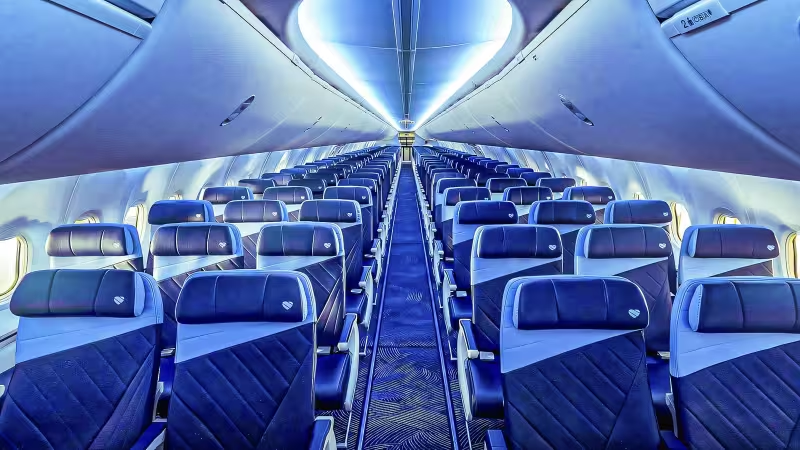
Southwest Airlines ended one of the most recognizable habits in U.S. aviation on January 27, 2026, abandoning open seating after more than five decades and replacing it with assigned seats and eight boarding groups. For a carrier that built its identity around an unusual boarding process, the change is more than cosmetic. It goes straight to the way the airline has moved airplanes, crews and passengers for 53 years.
The shift matters because Southwest built its business around speed. Open seating helped the airline minimize ground time and keep its Boeing 737 fleet moving, and that mattered across a network built on repeated short-haul segments throughout the day. Aircraft often complete multiple flights daily, so a small delay at the gate can ripple through an entire schedule. If boarding now takes even five extra minutes on average, the cumulative impact across more than 800 aircraft becomes enormous.
The new system also changes the passenger experience in ways that were visible almost immediately. Early reports described travelers stopping in the aisle, backtracking through the cabin and slowing boarding while searching for storage space near their assigned row. On a narrowbody aircraft like the Boeing 737, only one passenger can move through the aisle at a time, which means every hesitation blocks the flow behind it. What once was a fast, if sometimes chaotic, first-come process now has the markings of a more conventional boarding system, with more time spent getting people into the right place before takeoff.
Southwest kept open seating for decades not simply because passengers liked it, but because it was operationally efficient. The airline’s model depended on rapid turnarounds, and for 53 years that system matched the way it used its fleet. The decision to move to assigned seating and eight boarding groups shows how far the carrier has drifted from the setup that made it distinct. The open question now is not whether the airline can sell the new boarding system to travelers, but whether it can preserve the daily aircraft utilization that made the old one work.
The pressure points are obvious. The boarding change raises questions about gate availability, crew scheduling, maintenance timing and how much slack remains in a network that depends on short-haul flying and repeated departures. Southwest has more than 800 aircraft in service, and its schedule leaves little room for a process that gets slower in one place and does not come back anywhere else. The airline has traded a signature trait for a more familiar boarding model, and the test now is whether the rest of its operation can absorb the extra minutes without paying for them somewhere else.