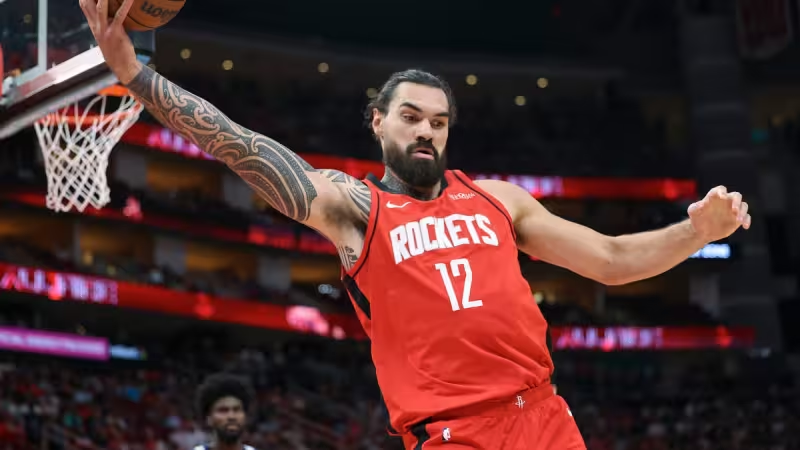
Steven Adams suffered a severe ankle injury early in the 2025-26 season and missed the final 50 games of the regular season and the playoffs, collapsing Houston's plan to play him in tandem with Alperen Sengun.
The absence was consequential on the court and on the ledger. Adams, a 12-year veteran who had two more seasons on his contract, missed 196 of a possible 328 regular-season games over the last four seasons. When he did play last year he averaged 5.8 points, 8.6 rebounds, 1.5 assists and 0.6 blocks in 22.8 minutes per game, shot 50.4 percent from the field and improved his free-throw rate by nearly 12 percentage points to 58 percent. He also tied Donovan Clingan for the NBA lead in offensive rebounds per game at 4.5.
Houston had explicitly penciled Adams into its frontcourt plans for 2025-26, prepared to pair his physical, offensive-rebounding game with Sengun's interior skill. The Rockets reached the postseason without him — and without Kevin Durant and Fred VanVleet — and Adams did not play at all in the series against the Los Angeles Lakers.
Those numbers explain why the Rockets kept faith in him despite the injury history: Adams remains one of the league's most reliable offensive rebounders and a dependable interior defender when healthy. But the missed games are the counterweight to that value. Missing more than half of four seasons' regular games cuts into any coach's rotation plans and any front office's long-term roster construction.
The tension is straightforward and unavoidable. Adams' rebounding and field-goal efficiency — he shot just over 50 percent — are tangible assets next to Sengun. Yet his recent availability record and a free-throw percentage that, even after a marked improvement, sits at 58 percent, complicate his fit as a core rotation piece. The Rockets publicly hoped his health would improve as he ages; the season-ending ankle injury made that hope a pressing operational problem rather than a future question.
With two seasons left on his deal, Adams represents both a solution and a risk. If he can stay on the floor, his offensive rebounding and physicality would help Houston's matchup problems and ease pressure on younger teammates. If he cannot, those two remaining seasons look like a growing liability for a team that missed three of its expected postseason pillars in that Los Angeles series.
The single most consequential unanswered question now is whether Adams can translate his flashes of high-impact play into sustained availability over the next two seasons — a reality that will determine whether Houston's gamble on his pairing with Sengun pays off or becomes a costly mismatch of expectations and minutes.