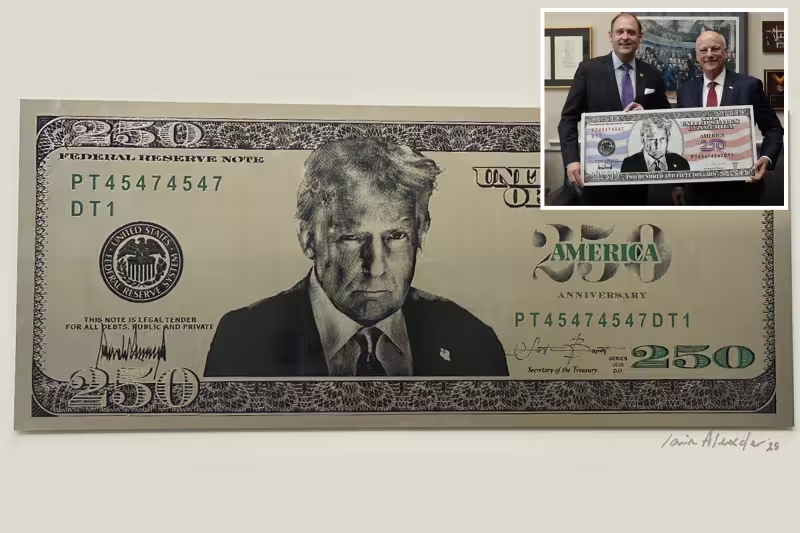
Donald Trump’s loyalists at the Treasury pushed the government’s money-printers to draw up a $250 bill bearing his face, according to a report that lays out a months-long internal campaign to turn a political idea into a prototype.
The push came from U.S. Treasurer Brandon Beach and his senior adviser, Mike Brown, who repeatedly pressed staff at the Bureau of Engraving and Printing last year to create Trump banknote designs. Beach handed bureau staff mock-up images in August and September, including one that put Trump’s face in the center of the proposed note. The paper trail, as described in the report, shows how far the effort went before any law had cleared Congress.
The idea was tied to celebrations for the 250th anniversary of America’s founding, a milestone that has already inspired a run of political proposals. Lawmakers floated a bill last year to let Trump appear on a $250 note in time for the country’s 250th birthday, while Rep. Andy Barr has pushed for the same concept and Rep. Brandon Gill separately rolled out legislation to put Trump’s face on the $100 banknote. Another bill, introduced by Rep. Jimmy Gomez in April, would bar Trump’s signature from appearing on the greenback. None of the proposals has gone through.
The legal barriers are plain. The Thayer Amendment, passed in 1866, makes it illegal to put the likeness of a living person on official U.S. currency, bonds or other financial notes. And under another law, $250 is not among the denominations the United States is limited to using. That left bureau staff dealing with a proposal that had political momentum but no clear statutory path.
Patricia Solimene, then the bureau’s director, warned that the note was not authorized and could take years to produce. In a phrase that captured the pressure around the project, she later said, “The buck stopped here.” She described her departure with a “heavy heart” and said it was “not my choice.” Solimene was abruptly reassigned on April 27, and Mike Brown later became the acting director of the agency.
Former bureau director Larry Felix said the bill was “not statutorily authorized” and noted that the last $100 redesign took more than 10 years to complete. That timeline matters because even supporters of the $250 bill were asking the bureau to move on a schedule far faster than the agency’s usual work. The same report said Treasury has already approved printing $100 bills bearing Trump’s signature, and that those notes are now rolling off the presses in downtown Washington, D.C.
Treasury said the Bureau of Engraving and Printing is “conducting appropriate planning and due diligence” and that, “should this legislative mandate be signed into law, the BEP is moving proactively to produce a $250 commemorative note which will appropriately recognize the 250th Anniversary of our great nation.” The department also said it had “never asked staff to print the bill before congressional passage.”
For now, the answer is straightforward: the $250 bill exists as a political project and a set of mock-ups, not as authorized currency. Unless Congress acts, the living face at the center of the proposal cannot legally reach the nation’s wallets.