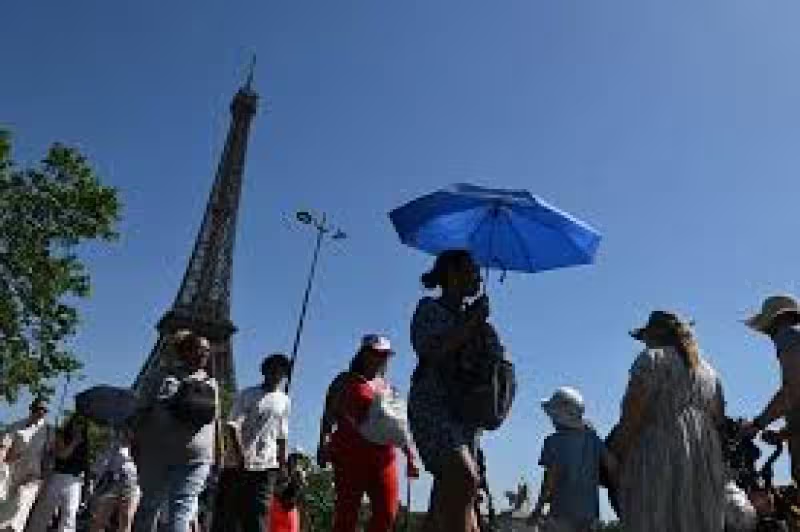
France is sweltering under an unprecedented early-season heatwave, Météo‑France said, and climate scientist Friederike Otto called the scale of the event "Absolutely astonishing."
Hundreds of heat records have been broken around France during the current spell. Temperatures across western Europe have been unusually high for spring: the UK passed 35C on Tuesday, more than 2C above the previous May record for the island, and the May temperature record for the island of Ireland has been surpassed by more than 2C. Elsewhere, Germany, Italy, Spain and Switzerland have faced similar early-season warmth; temperatures reached 45C in Delhi, India, underscoring the global sweep of the event.
The immediate cause of the surge is a heat dome that traps warm air beneath a zone of high pressure stuck over Europe, meteorologists say. Scientists say human-caused climate change has supercharged that dome: Europe has been warming by 0.56C per decade over the last 30 years, according to the Copernicus climate service, raising the baseline on which these extreme spikes ride.
For anyone checking paris weather, the local forecast is simply part of that larger picture — the city and the wider country are under the same high-pressure pattern that has produced record after record elsewhere in France and across the continent.
Those records are not merely being nudged aside. The scale of the breaks is forcing scientists to reframe how they think about extremes. "If someone beats a world record in high jump, you would expect them to beat it by one centimetre and not suddenly by 20, 30 centimetres and the same holds for the weather," said Erich Fischer, describing how some temperature records have been exceeded by margins that would once have seemed implausible. He added that where a century or 150 years of measurements exist, "you would have probably expected it to be broken by a tenth of a degree and not suddenly by two degrees or three degrees."
Researchers reacting to the unfolding event used unusually blunt language. Peter Thorne called it "Mind-bogglingly crazy," and Richard Betts warned: "When we have a heatwave it's happening more severely, because it's on top of a warming climate." Those assessments echo the numerical backdrop: hundreds of records and a steady warming trend of 0.56C per decade over the last 30 years.
There is a friction between the immediacy of the weather maps and the longer, slower rise of the climate baseline. A heat dome is a short-term meteorological phenomenon; the long-term warming recorded by Copernicus makes each dome more intense and each record more likely to shatter by larger margins. That combination explains the tension implicit in the data — dramatic single-day temperatures stacked on top of a multidecadal climb in average conditions.
The practical consequence is clear: what Paris, and much of France, just experienced will be read not merely as a weather anomaly but as evidence of how extremes are changing. The heat dome that is currently pinned over Europe is the proximate cause, but scientists point to human-caused warming to explain why the event has become so extreme and so early in the season.
This matters today because the pattern is not theoretical; it is happening now, and the numbers show it. Hundreds of records have already fallen, spring conditions across western Europe are unusually hot, and the margins by which records have been broken — in some places two degrees or three degrees beyond older records — indicate a new scale of extremes. For readers in Paris and beyond, the arrival of these conditions should be understood not as an isolated spike but as part of a broader, warming climate that amplifies every heat dome that forms.