Boston Consulting Group said on Wednesday that Hong Kong has overtaken Switzerland as the top global booking center for cross-border wealth, rising to $2.95 trillion from a narrow lead over Switzerland’s $2.94 trillion.
The shift accelerated last year as wealth from China and an IPO boom in 2025 pushed flows into Hong Kong’s offshore system, BCG reported in its 2026 Global Wealth Report.
Cross-border wealth globally grew 8.4% to $15.7 trillion last year, the report found, and that growth landed overwhelmingly in the world’s top 10 booking centers. BCG authors wrote: "Hong Kong is cementing its role as China’s gateway to global markets, though that same concentration ties its trajectory tightly to economic and regulatory developments on the mainland," and the consultancy said this was a first and was unlikely to be reversed as hubs in Asia grow faster than the European safe haven.
BCG projects Hong Kong and Singapore will continue expanding as cross-border booking centers at around 9% annually through 2030, compared with Switzerland’s expected average growth of about 6% over the same period. The numbers underline how quickly Asia’s financial plumbing is scaling up to receive wealth booked outside clients’ home jurisdictions.

That growth is not uniform. BCG also warned that "Geopolitical uncertainty reaffirms Switzerland’s role as a core global booking center, attracting flight-to-safety flows from more volatile regions such as the Middle East," and the report noted wealthy individuals have been looking to shift assets from the Gulf region to Switzerland in the wake of the ongoing Iran war.
The tension is straightforward: Asia’s hubs are rising because of China, but they are more exposed to mainland developments than Switzerland, which benefits from a broader geographic client base. Michael Kahlich put the practical point plainly: "What ultimately matters is client proximity." Kahlich said that two hubs are forming globally — Singapore and Hong Kong for Asia, and Switzerland, Britain and the United States for the Western region — and that global banks are shaping footprints around where clients cluster. He added, "UBS is number one in wealth management in both Singapore and Hong Kong."
The result is a bifurcated map. For asset owners and their advisers, booking choices are increasingly binary: the Asian corridor or the Western safe havens. Cross-border wealth flows last year reinforced that concentration; the top centers captured most of the increase and are set to take more market share if current trends continue.
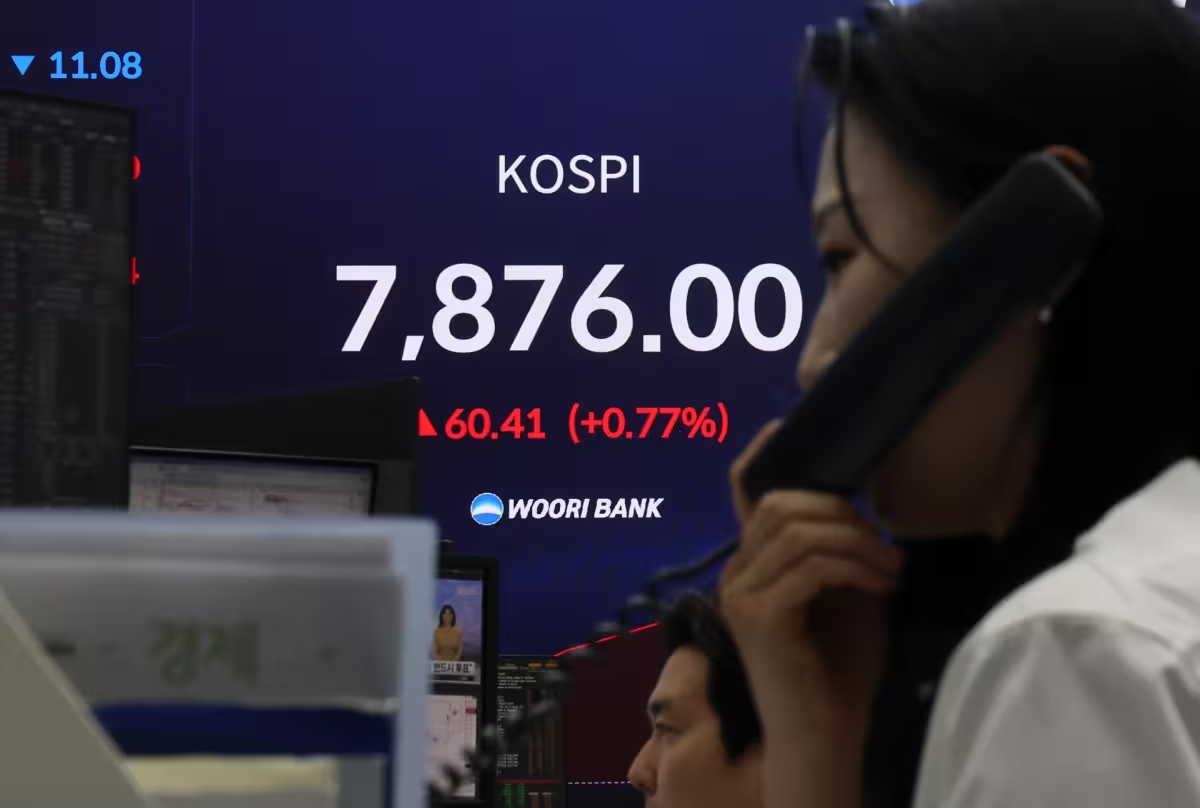
Practical developments in Hong Kong add to the picture: secondary market activity and new product proposals keep interest elevated in the city’s listings and fund landscape (see Sk Hynix Stock Interest Rises as CSOP Plans KOSPI 200 ETF in Hong Kong — But the same dynamism that lifts Hong Kong — rapid Chinese wealth creation and capital markets activity — also creates a single-country dependency that Switzerland largely avoids.
BCG’s numbers make a clear judgment: the move is historic and, on present evidence, durable. Yet that durability is conditional. If Chinese growth or regulatory policy around capital flows shifts materially, Hong Kong’s lead could be tested more sharply than Switzerland’s would be. For now, banks and their clients seem to be choosing proximity over the old safe-haven default, and that client choice is remapping where the world keeps cross-border wealth.