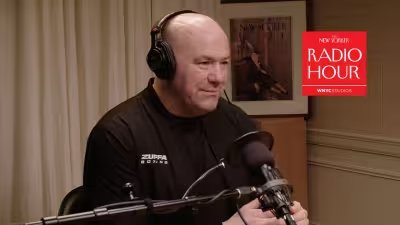
Bill Maher told listeners on Wednesday’s episode of Billy Bush’s Hot Mics podcast that he initially supported President Trump’s decision to strike Iran but now believes the move has become a dangerous mess with no clear exit strategy.
"I’m supportive of the idea of going into Iran. I thought that was a good attempt," Maher said, adding: "What I hope he does now is realize it didn’t work." He told host Billy Bush, "Now let’s not make a bad situation worse. Let’s get out of this as cleanly as we can, and we’ll try again at some point if we have to."
Maher’s reversal came as the conflict enters its 13th week and after a string of developments that have undercut arguments for a prolonged U.S. campaign: negotiations have repeatedly stalled while violence continued in and around the Strait of Hormuz, which carries roughly 20 percent of the world’s oil supply, and gas prices surged to a national average of $4.46 a gallon.
The timeline of recent escalations is stark. On April 22, Trump announced an extension of a ceasefire framework with Iran while U.S. forces continued enforcing a naval blockade in the Strait of Hormuz. Hours after that announcement, Iran reportedly attacked three commercial vessels in the region. In May, Trump said the U.S. would help "free up" ships stranded near the strait; hours later, Iranian outlets claimed missiles struck a U.S. warship near the southern end of the waterway.
Public opinion, too, has hardened. An Ipsos poll conducted in May found 52 percent of Americans believed the war had not been worth it, and just 23 percent said the military action was justified — figures Maher cited as part of his argument that the costs and strategic clarity of the campaign are in question.

Maher did not rule out the original rationale for action. He reiterated a comment that has drawn particular attention: "They should have started the war when the people were in the streets." He also referenced the American Civil War in a way certain to provoke debate, saying, "The Civil War was a great endeavor, and it cost 600,000 lives," and suggesting that regime change in Iran could "transform the Middle East."
That push-and-pull in Maher’s remarks echoes the larger tension driving the conflict: a White House that has alternated between public pressure and diplomatic overtures, and an Iranian leadership that accuses the United States of sabotage. Iranian President Masoud Pezeshkian accused Washington of undermining talks through what he called "breach of commitments, blockade, and threats," while a senior Iranian official told that negotiations remained deadlocked over uranium enrichment and strait access.
The friction is visible in Mr. Trump’s own statements. He posted that the strait was "COMPLETELY OPEN" just before issuing a shoot-to-kill warning against Iranian vessels suspected of deploying naval mines, and last week he said a deal to obtain Iran’s enriched uranium was imminent — even as senior Iranian military officials warned American forces they would face retaliation for intervening.
Maher’s prescription is blunt: accept that the strike did not solve the problem and extract U.S. forces before the situation worsens. "So, it’s fine with me if this is where it stays, as far as damage done," he said, framing withdrawal not as defeat but as damage control with the option to act again later if necessary.
For now, the war has dragged on for more than 12 weeks, and the immediate next step is political: whether the White House follows the caution Maher urged or doubles down on pressure in the strait and on uranium negotiations. Maher’s public about-face underscores a broader shift — skeptics in the U.S. and abroad now press for a clearer exit plan rather than escalation.
Maher closed by forcing a choice he said Trump must make: acknowledge the strike failed and get out "as cleanly as we can," or risk turning a limited intervention into a deeper, costlier chapter in the region. That was his answer to how the U.S. should proceed: withdraw, repair, and reserve the option to return only if a clearer, more successful strategy presents itself.