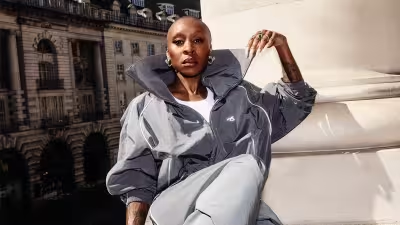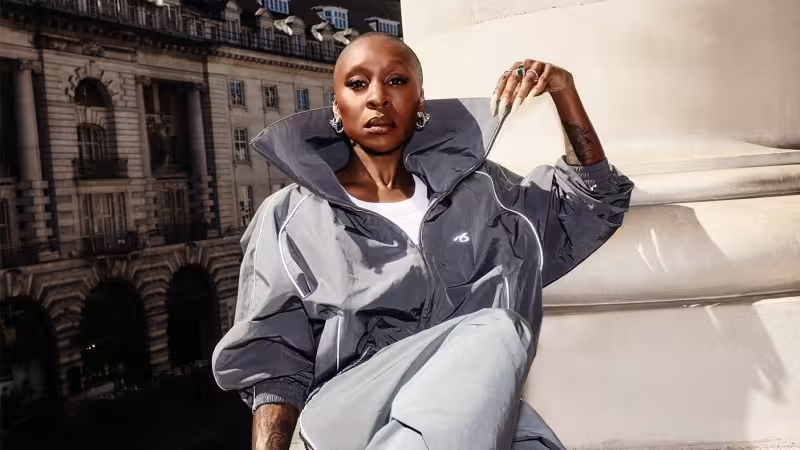
Cynthia Erivo said life inside the Wicked machine had been difficult over the past four years and that she and her co-star "were holding on by threads," speaking on a balmy April morning at the Hotel Café Royal in London while she was appearing on stage in Dracula at the Noël Coward Theatre and six months after the release of Wicked: For Good.
Her remarks cut against the glossy images the pair gave during the film's promotion: the two leading ladies helped turn the double-feature adaptation of the long-running Broadway musical into a $1.2 billion juggernaut, presented together at the 2024 Oscars clad in green and pink, and during their first press tour in November 2024 they did almost all their interviews together — Erivo in black or green, Ariana Grande in shades of pink.
Erivo said she and Grande made "a really conscious decision to nurture their relationship early on," and that choice, she suggested, was as much survival as branding. "I think that people didn't really believe that we were actually friends," she said, adding that the two still text almost every day. "If I'm a friend, then I'm a friend. If I'm not, then I'm not," she said.

That sustained attention is part of why the story matters now: by 2025 some observers felt Wicked and its leading ladies were overexposed after the pair began promoting the film a full nine months earlier, and the internet's appetite for the friendship has turned fraught as the franchise grew into its box-office scale. The casting of Erivo as Elphaba and Grande as Glinda ignited the internet from the outset, and the couple's decision to appear in coordinated colors and joint interviews only amplified the scrutiny.
Erivo pushed back on how neatly the public's narrative matched what she experienced. "It's very interesting, watching what people's perception is versus what the reality actually is," she said, and that mismatch has consequences when an audience reads a relationship as performance. "Lots of psychologists seated at home deciding who we were, what we were going through, what we were doing and why," she said. She also warned that embodiment of character can confuse observers: "That's the nature of the work, to truly embody and be different people," and, "Because I think sometimes, if I'm honest, people thought I was being myself, even though I was green."
There is a clear tension between the machinery of global promotion and the private decisions two actors made to protect themselves. Erivo said she and Grande were "really trying to take care of each other" inside that machine; the online interest in their friendship, the source says, became darker over time, testing that mutual care even as it fed publicity for a franchise that kept growing.
For now, the clearest fact Erivo offered is also the simplest: the closeness was deliberate and ongoing. Six months after the film's release, while she was onstage in a London theatre, she described two people who had actively chosen to build a friendship under pressure and who still communicate nearly every day. That matters because, in Erivo's telling, the relationship survived the machinery — and if the question is whether the friendship was real, her answer was emphatic: their bond was something they worked to protect and kept alive despite everything around it.