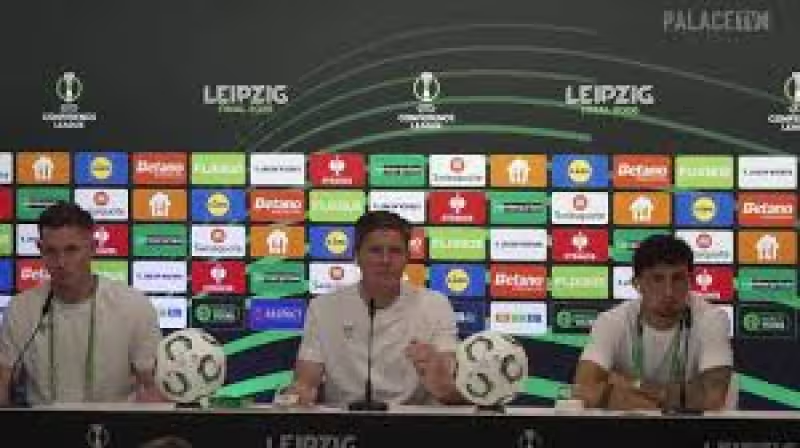
Crystal Palace played Rayo Vallecano in the UEFA Conference League final in Leipzig on Wednesday evening, a club milestone in Palace’s first-ever European season and the backdrop to Oliver Glasner’s last press conference as manager.
Glasner spent much of his appearance mapping the route the team has taken: they accepted the challenge on day one, began in Fredrikstad, stopped at the eastern border in Poland in Lublin, travelled to Shelbourne in Ireland and even went as far as Fiorentina — a journey that ended in Leipzig for a final he said would be his last in charge of the club.
The numbers underlined why the match mattered. Palace scored 25 goals across the campaign, took more shots and produced more efforts on target than any other team, and posted the competition’s best expected goals figure at 31.3. They scored six set-piece goals and kept five clean sheets while conceding 12 overall; like Rayo Vallecano, they won eight ties to get to Leipzig. Rayo themselves finished with 22 goals, 204 shots and 70 efforts on target, an xG of 20.1, two penalties earned and five dead-ball goals.
Those statistics explain how a club that had never played in Europe reached a final in its maiden continental season and why Wednesday’s game was billed as the capstone of a fast-moving two-and-a-half years under Glasner — a stretch that already includes an FA Cup triumph last May and a Community Shield victory in August. Glasner reminded reporters that he had previously won a European final in 2022 with Eintracht Frankfurt, and called it “outstanding” that a coach could reach two European finals with two different clubs within four years.

Glasner mixed tactical questions with personal history. He said he had looked back at what he did with Frankfurt and asked whether Palace should train at the stadium or at home before the final, a reference to preparations that a report said left Palace not training at the RB Arena before arriving in Leipzig. UEFA rules allow visiting teams to use the host stadium on the eve of a game, but Palace trained on the opposition pitch only twice in eight Conference League away fixtures — a detail Glasner admitted he weighed in the run-up to the final.
The press conference also carried a small contradiction that became the story’s tension. Glasner reminded journalists of a promise he once made — after a midweek match before a derby last April he said he would never again change 11 players — and then noted bluntly, of this run, that he had in fact changed 11 players at a point in his tenure. He presented that flip as experience: players need to be read for nerves or overconfidence, and every experience can help.
He kept the human notes short. He told the squad to relax, to laugh, smile and be themselves, and said he wanted to repay the fans for two years of work with the group. He pointed out the proximity for supporters travelling from Austria — saying the ticket queues were large because Austria was only about five hours by car — and vowed the team would give its best to try to secure a happy ending.
The immediate facts are straightforward: this was Palace’s 60th game of the season, their first European final, and Glasner’s farewell press slot before the match. What follows is binary and consequential for both club and coach. If Palace lift the trophy, the victory will tidy a rare haul — FA Cup, Community Shield and a European title inside two-and-a-half years — and leave Glasner’s short tenure defined by silverware. If they do not, the season will still stand as a remarkable first European campaign, and the question of how Palace prepare for major matches — where to train, how many changes to make — will become the sharper lesson to take into the next era.
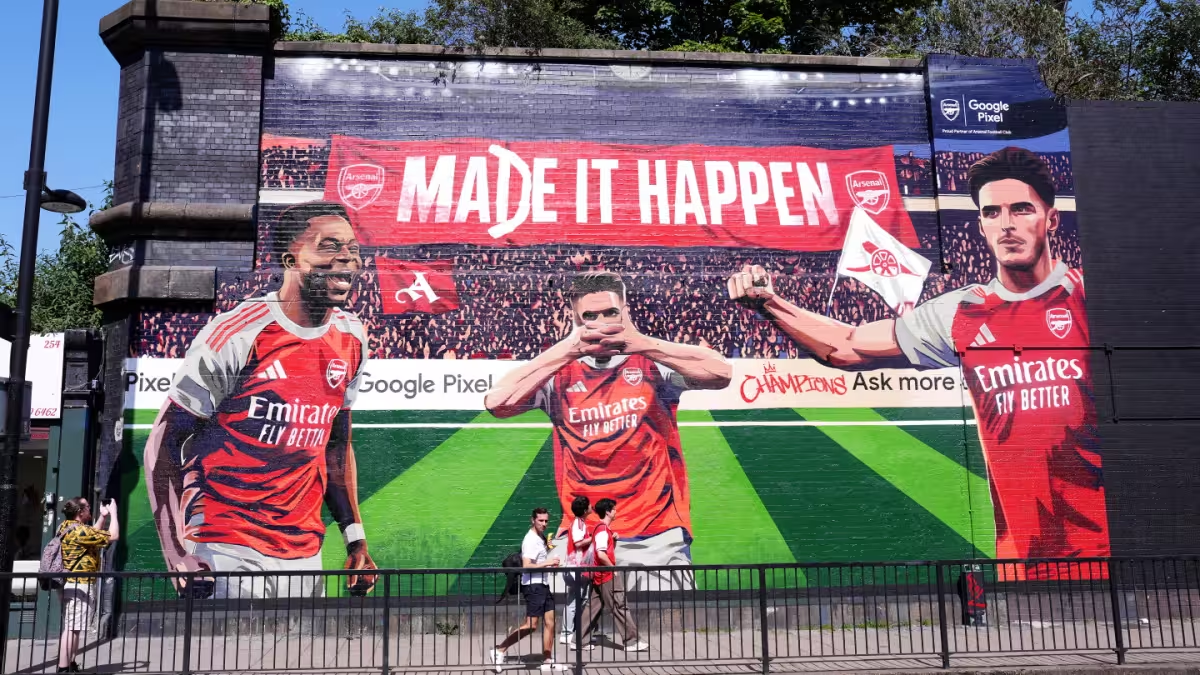
For readers wanting background on Palace’s domestic season, see Arsenal Vs Crystal Palace: Gunners to Lift Premier League Title at Selhurst Park for related context on a campaign that intersected both league and cup storylines.