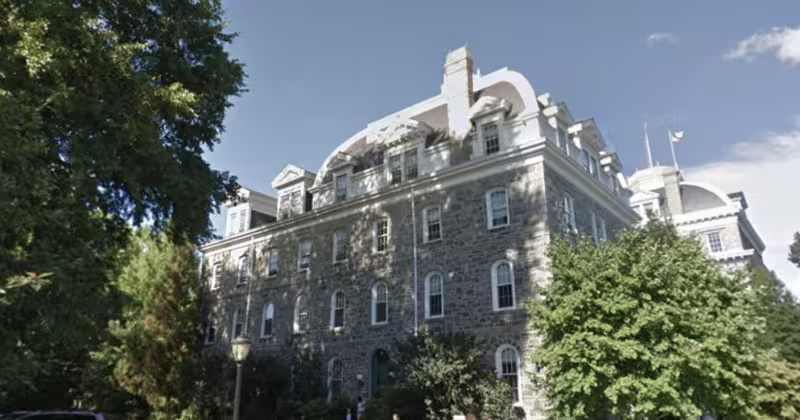
Swarthmore College will guarantee tuition coverage beginning in the 2027–28 academic year for domestic students from families earning $200,000 or less a year, if they also have typical assets. The private liberal arts college in Pennsylvania said the Swarthmore Tuition Guarantee is meant to make its price tag easier to understand and to widen access for families who may have assumed the school was out of reach.
President Valerie Smith said the plan reflects the college’s belief that a student’s curiosity, creativity and talent should determine what is possible, not whether a family can pay tuition. She also said the aim is to show families that financial circumstances are not a barrier to what the college sees as a transformational education, and to make clear that even households earning $200,000, $250,000, $300,000 a year — and in some cases more — may still qualify for aid.
The announcement lands as Swarthmore continues to spend heavily on aid. Its financial aid program is set to rise to more than $71 million in the 2026–27 academic year, and the college says the program is fully funded by its endowment. Swarthmore already meets 100% of determined financial need for all students through loan-free aid, and more than 55% of its students receive assistance. Average aid awards are about $75,000 per year.
The cost of attendance helps explain why the new guarantee matters. For the 2026–27 academic year, tuition was $72,722, housing cost $11,676, food cost $10,890 and the student activities fee $482, bringing the listed total to over $95,000. Swarthmore enrolls about 1,700 undergraduate students, a relatively small student body for a school that draws national demand. For the 2026 freshman class, the college received 13,029 applications and admitted about 7.4% of applicants.
Jim Bock, who oversees admissions and financial aid, said the school believes everyone benefits from a community shaped by different perspectives and experiences. He said Swarthmore has worked for more than a decade to expand access and is building on that effort with the new guarantee. The college said its financial aid methodology and application process will not change when the program starts.
The policy is open to domestic students only, though international applicants may still qualify for aid that covers all of their tuition and other expenses. That distinction matters because the college is trying to simplify a message that often gets lost in the higher-education pricing maze: the sticker price is not what many students actually pay, and for some families, the new guarantee draws a harder line by removing tuition from the equation entirely.
Announcing the program now gives Swarthmore a sharper pitch heading into another admissions cycle. Annie Hauze, a student, said the college’s financial aid has been generous and that she is thrilled to expect to graduate debt free. For a school with a tiny undergraduate population and a highly selective admissions process, the message is clear enough: Swarthmore wants middle-income families to see tuition as a promise, not a barrier.