
Ellie Bamber portrays Kate Moss for the first time onscreen in Moss & Freud, which opens in U.K. cinemas on Friday; Kate Moss is credited as one executive producer on the film, which James Lucas directed and which examines her relationship with the late painter Lucian Freud, played by Derek Jacobi.
The film arrives with a piece of art history attached: Freud’s nude portrait of Moss sold in 2005 for around £3.5 million — about $5.3 million — a fact the story uses to underline how private sittings between artist and subject spilled into public spectacle.
Bamber says the part landed in a moment as ordinary as it was surreal. "I was in my kitchen in my dressing gown, and I remember getting an email and them calling me, being like, 'Hey, want to play Kate Moss?' And I was like, 'Oh, wow.'" She called it "one of the most exciting emails that I’ve had." The casting posed an obvious pressure: "With Kate being as iconic as she is, this was going to be a totally different challenge," Bamber said.
She admitted she came to the role from a place of nerves. "I was mostly terrified, honestly," she said, and that terror shaped her approach. Small, specific details mattered: "Her laugh is so specific," Bamber said, adding, "It was, weirdly, really important to me." Those particulars guided the performance even as she tried to hold the larger image of Moss in view.
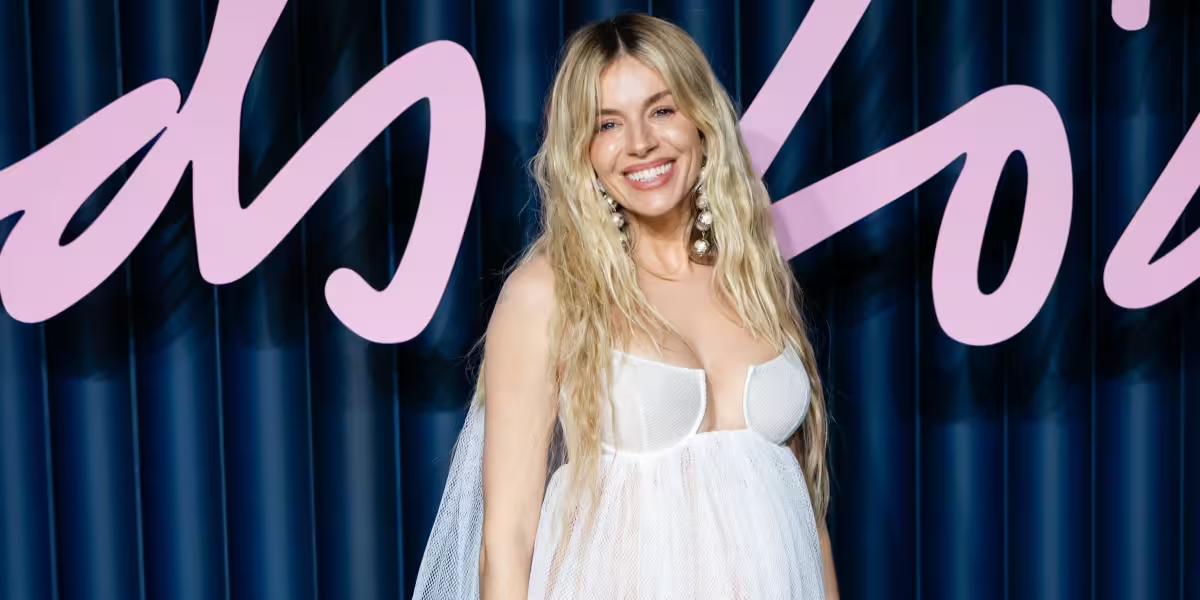
Bamber described the work as trying to reconcile two truths about Moss: the surface poise and a quieter interior. "But I would say that she has this confidence, so it was easy to step into her and feel suddenly quite empowered… She was thrown into the industry at such a young age, and had such a savvy way of moving through it [with] grace and poise," she said, adding that "she also had this deep vulnerability underneath."
That balance — iconic visibility versus private fragility — is the film’s stated terrain. Moss & Freud focuses on the relationship between model and painter rather than on the wider celebrity arc, and bringing kate moss to the screen for the first time required both technical mimicry and emotional interpretation. Bamber comes to the role after a steady string of British film and TV parts, including Pride and Prejudice and Zombies, Nocturnal Animals, The Trial of Christine Keeler and Red, White & Royal Blue; she is also attached to several forthcoming projects, among them Red, White & Royal Wedding, Animal Friends and Ti West’s Ebenezer: A Christmas Carol.
There is, nonetheless, a clear point of friction between what is visible in the film and what remains offstage. Moss’s name sits on the credits as an executive producer, but Bamber left room for uncertainty about how involved she was in shaping the performance: "I don’t know. I assume that she was a part of the process, because she’s a producer on the film," Bamber said. That ambiguity — a subject who appears in a dramatization of her own history while also holding a production title — complicates claims of objectivity and invites scrutiny over whose version of events the movie ultimately privileges.
James Lucas’s direction and Derek Jacobi’s casting as Freud give the picture another layer: a respected actor representing the celebrated painter who produced the portrait that later achieved headline prices at auction. The sale figure from 2005 serves as a reminder that private encounters between artist and sitter were soon translated into market value, and Moss & Freud positions itself to interrogate that transformation.
By Bamber’s account, the performance aims to do more than imitate. She says Moss’s public armor is real and that locating the vulnerability underneath was the role’s project. If the headline question is whether a first onscreen kate moss can feel both recognizably iconic and quietly human, Bamber’s preparation and her insistence on small truths — a laugh, a posture, a moment of empowerment — argue that the film will try to show exactly that when it opens on Friday.