
Epic Games debuted a short teaser trailer for a redesigned Rocket League during the Rocket League Paris Major that showed in‑game cars rendered in Unreal Engine 6 and billed the moment as a new era.
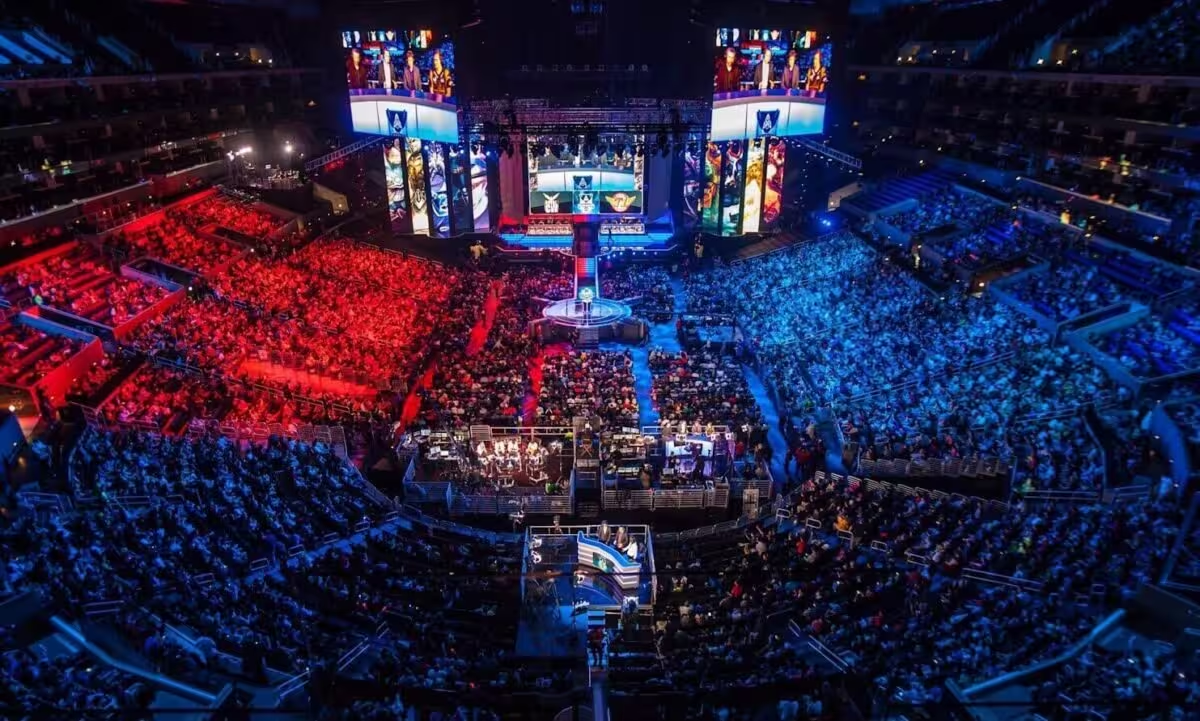
The teaser ran in front of the Paris crowd and ended with the Unreal Engine logo carrying a six appended to its side; Psyonix wrote in the video description, "What. A. Moment. The crowd reacts to the new era of Rocket League." The footage shown was captured in real time inside the game.
That single trailer carried the weight of the announcement: it confirmed a version called Unreal Engine 6 exists at least as a working render pipeline, and it placed Rocket League — a game that launched in 2015 and still runs on Unreal Engine 3 — on a direct upgrade path to that next generation of the engine.
For context, Unreal Engine 5 was first revealed in 2020 and shipped in 2022; the current stable build of the engine is 5.7. Epic Games released none of the usual follow‑up detail on a product page: there was no release date, no public feature list, and the company did not specify what upgrades Unreal Engine 6 would bring to Rocket League.

The gap between spectacle and substance is the story's tension. The teaser gave viewers a visual demonstration — real‑time gameplay rendered in the new engine — but left engineering and customer questions unanswered. Epic Games provided no timetable for Unreal Engine 6, no breakdown of technical improvements, and there was nothing on Epic's website elaborating on the new engine after the trailer premiered.
For fans and developers the teaser raises immediate, practical questions: how will a move from Unreal Engine 3 straight to Unreal Engine 6 change performance, graphics pipelines, or modding support for a title that has been on an older engine since its 2015 release? Epic Games did not specify which of those areas would be affected, and Psyonix confined its public comment to the moment captured in the video description.
The move matters today because it reframes Rocket League's technical trajectory in a single, attention‑grabbing shot. Showing in‑game cars rendered in Unreal Engine 6 signals that Epic has at least a working implementation for a high‑profile live title; it also sets expectations that the developer community and players will seek concrete answers about compatibility, rollout, and timing.
What happens next is simple and consequential: Epic Games must supply the details the teaser withheld. The most urgent unanswered question is when Epic will publish a release schedule and technical documentation for Unreal Engine 6 — and with it, a clear plan for migrating a 2015 game built on Unreal Engine 3 to a platform that has not yet been publicly described beyond a teaser.