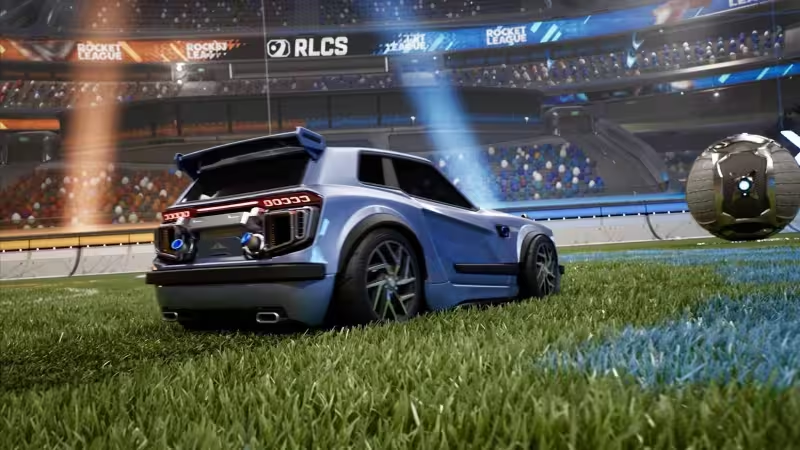
Epic Games and Psyonix announced at the 2026 Rocket League Championship Series Paris Major that Rocket League will move to Unreal Engine 6, and a brief clip shown during the semi-finals made the game look nearly photorealistic.
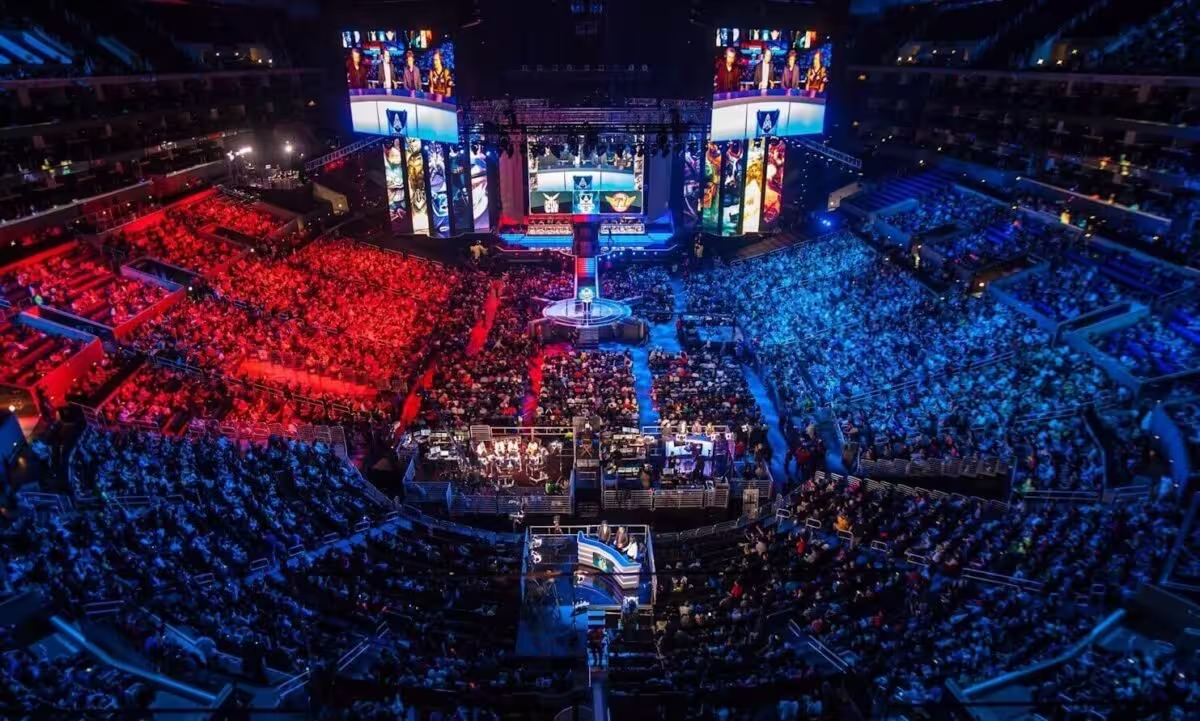
Mauricio Longoni, speaking at the event, told the packed venue the title should be understood on its own terms: "We call [Rocket League] its own sport," he said, adding that "it's not a simulation of soccer. It's not a simulation of volleyball. It's its own thing." The Paris Major — presented as Rocket League esports' biggest-ever in-person tournament — drew a crowd at a venue capable of holding up to 25 thousand fans as 16 teams competed for the largest share of a $350 thousand prize pot.
The announcement landed in the middle of the semi-finals, a high-stakes moment: three French organizations — Karmine Corp, Team Vitality and Gentle Mates — were among the 16 teams, and Karmine Corp and Team Vitality were set to face each other to decide who would take on Twisted Minds in the Grand Finals. Epic Games also brought its own server team to Paris to guarantee zero lag, and the production team received real-time data every two seconds so each team experienced the exact same ping.
Cliff Shoemaker, addressing the production side of the show, underlined how extensively Unreal is already baked into the live experience: "The vast majority of everything you will see in broadcast, even in-arena triggering of lights, the light panels on the floor, [the in-game and arena cameras],is all being used by Unreal Engine," he said. "I think the real-time rendering of everything opens up a lot of doors." The clip of Rocket League running on Unreal Engine 6 leaned into that pitch — the visuals looked nearly photorealistic in the brief demonstration.
The move marks a major technical shift for a game originally built on Unreal Engine 3. Rocket League first launched in 2015, 11 years before the Paris Major coverage, and the engine that carried it for more than a decade has been described by the team as a constraint on the pace of updates and a steeper learning curve for junior developers. The switch to Unreal Engine 6 is being framed as modernization: better real-time rendering, deeper integration between broadcast and arena elements, and new production possibilities.
That context explains why talk of a rocket league unreal engine 6 move dominated conversation at the event, but it also sharpens a familiar tension. Rocket League is physics-based and player ability-based by design — "It's simple, but not simplistic," Longoni said — and players have long worried that moving to a new engine could change how the ball reacts to cars and alter the game's core feel. The Paris Major demonstration gave visual answers about fidelity but no technical timetable: Epic and Psyonix did not provide a release timing for the Unreal Engine 6 version.
The production claims complicate that worry. Epic's investment in servers and Shoemaker's assertion that Unreal already handles in-arena lighting, floor panels and camera systems suggest the company sees the engine as more than a graphics upgrade; it is a backbone for synchronized, real-time production. Meanwhile the team behind Rocket League continues to expand the brand with tie-ups outside esports, from WWE to LEGO and Jurassic Park, and registrations for the Rocket League Championship Series are growing globally at an average of over 24% per year.
What matters now is not the clip's visual polish but what comes next: a clear release plan and proof that the physics players depend on will survive — or improve — under Unreal Engine 6. Mauricio Longoni's assurance that "the ceiling is infinite because it's physics-based and it's player ability-based" frames Psyonix's position, but without a date or technical details the community will judge the upgrade by a single measure: whether the game feels the same when it hits players' screens.