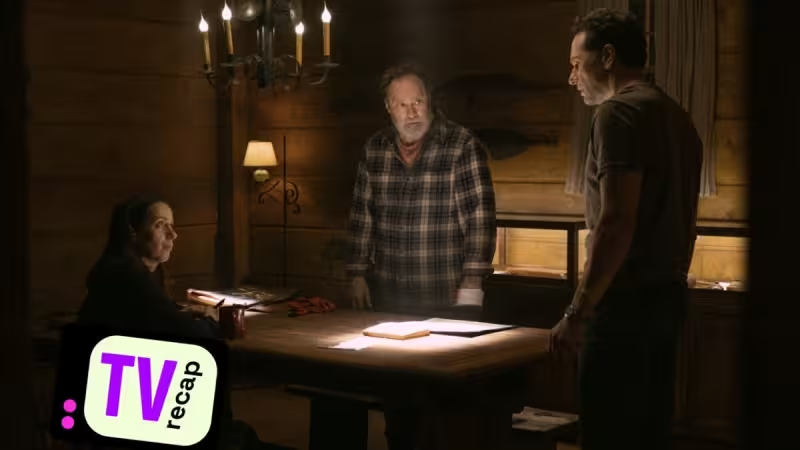
Apple TV released two new episodes of Widow’s Bay this week — "Our History" and "Seasickness" — arriving a week after Mayor Tom went on a mushroom-enhanced journey through space, time, reality and property damage in "What to Expect on Your Trip."
Those two episodes push the series deeper into the island’s origin story and its central villain: Richard Warren, who the show identifies as the founder of Widow’s Bay. The timeline dropped in "Our History" is plain and specific — Warren led the first settlers to the island in 1681; Sarah Westcott Warren arrived from the mainland in 1702 to marry him. Sarah’s diary, shown in the museum, records her "nervous excitement" on arrival while a violent plague ravaged the settlement. The show dots its i’s: Richard held the titles Reeve Prime of the Colony and the Lord Island Protector, and he fathered five children. But the portrait the museum keeps is not just ceremonial — it sits beside entries that describe a man consumed by mysterious "work," seen out at all hours and, on his wedding night, observed by Sarah in an eerie trance with a cylindrical object on the table beside him.
From there the series catalogues a darker ledger: Richard beat a visitor to death after the man asked about his connection to the island; Sarah discovered a trap door and a hidden room that led to a network of tunnels, including a chamber with a lone chair facing a large set of doors. The local pastor told Sarah that many islanders had come to believe Richard was in league with the devil, and the pastor all but forced her to become part of a community assassination plot. The sequence closes on the most dramatic fact: Richard did not die when a knife-wielding intruder attacked him that night.
Context for that history lands after the episode evidence, and the show makes the bridge explicit. Richard Warren had been mentioned earlier at the historical society as the island’s founder; the museum diary and a historical portrait now link the present-day plot to those 17th- and 18th-century pages. The two new episodes arrive while Mayor Tom’s mushroom-related episode still hangs over the town’s behavior and decisions — his pleading with God to protect his son, Evan, in last week’s hour connects individual panic to the larger, inherited dread the series calls the island’s curse.
Where the narrative tightens, the tension becomes obvious. The man who officially founded Widow’s Bay is the same figure islanders privately call the reason for the curse. That contradiction — founder and monster in one person — drives the show’s friction: a community that owes its existence to Richard Warren also suspected him of devilry, plotted to kill him and failed, and kept his portrait and titles on public display. The show leans into that bad faith: institutional reverence sits beside lurid accusation, and the physical traces Sarah uncovers — hidden rooms, tunnels, the chair and the doors — refuse a tidy explanation.
Those contradictions matter because the episodes do not treat the past as background; they make it active. By centering Sarah Westcott Warren’s diary and Richard’s role as both Reeve Prime and Lord Island Protector, "Our History" turns civic origin into moral rot. "Seasickness" follows with imagery and mood that suggest the island’s sickness is not merely biological but structural, a corrosion at the foundation of the town’s story. And Mayor Tom’s recent mushroom trip, shown last week, refracts those revelations into the present: his panic, his plea for his son Evan, are not incidental character beats but symptoms of a community coming to terms with what its founding really cost.
The clearest conclusion the episodes deliver is also the simplest: Widow’s Bay is explicitly tying its present violence and unraveling to Richard Warren’s actions and the secret places he kept. The show doesn’t leave his survival ambiguous — the record in Sarah’s account shows he survived an assassination attempt — and by making that survival part of the canon, the series makes a judgment the island’s public record never quite could. The net effect is this: the founder is not merely a historical footnote but the hinge of the story, and the town’s future will be shaped by the same hidden doors and tunnels the past left behind.