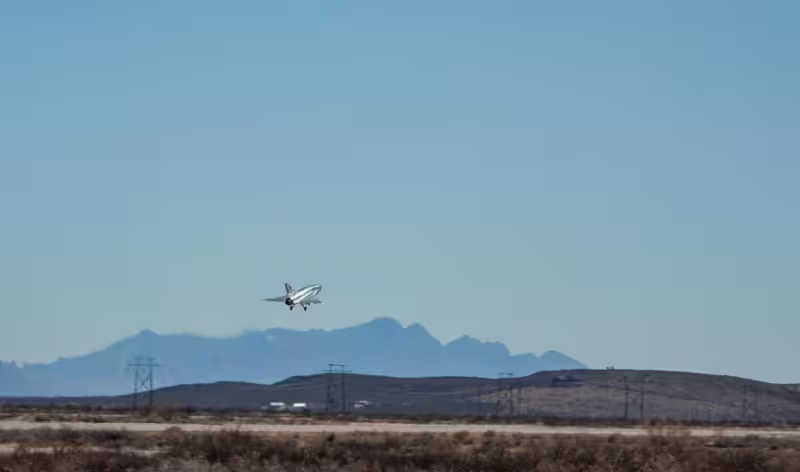
Hermeus said last Wednesday that its uncrewed Quarterhorse aircraft hit supersonic speed over a New Mexico military base, a test flight the seven-year-old company described as the first privately developed jet in the world to reach that mark. The aircraft flew at 1.21 times the speed of sound, or roughly 930 miles per hour.
The result matters because Hermeus has spent years trying to move from concept to a jet that can operate beyond the sound barrier and eventually into hypersonic flight, more than five times the speed of sound. Zach Shore said the company needed to show the airplane was stable through the transonic speed range, and said the test removed a major risk from the program.
Shore called supersonic flight a huge milestone and said it would be a massive tailwind for the company. He added: “I needed to show that my airplane was stable through the transonic [speed range],” and later summed up the outcome bluntly: “We did that. Boom. Great. That’s a huge risk off the table. Now I know my airplane’s stable.”
Hermeus, based in El Segundo, California, has been building toward this point since the Pentagon awarded it a $60 million contract in 2021 to continue developing and testing the Quarterhorse. The company says it hopes to reach Mach 2 this year and Mach 3 in the first half of 2027, while the longer-term goal of hypersonic flight is still at least several years away.
The flight also lands in a crowded and increasingly well-funded corner of aerospace. Sam Altman first backed Hermeus in May 2022 when he led its $100 million Series B round, and Peter Thiel took part in that raise as both an individual investor and through Founders Fund. Founders Fund came back in April, joining Hermeus’s $350 million Series C round that valued the company at $1 billion.
Altman has also invested twice in Boom Technology, a rival pursuing a different pitch: bringing back supersonic commercial air travel. Boom’s XB-1 aircraft completed its first successful supersonic test in January 2025 and the company was valued at $1.5 billion in a December funding round. The field has been dormant since the Concorde was retired in 2003, but the latest tests suggest the race to revive faster-than-sound flight is no longer just a matter of presentation slides and long-range promises.
There is also a strategic edge to the work. The U.S. military wants an operational fleet of hypersonic vehicles as China and Russia invest heavily in their own programs, giving companies like Hermeus a defense rationale that goes beyond commercial speed. The Office of Science and Technology Policy framed the moment by saying America is at the threshold of a bold new chapter in aerospace innovation and that faster, quieter, safer and more efficient air travel is on the horizon. Elon Musk’s public response to the test was just one word: “Cool.”
For Hermeus, the bigger answer is already on the board. After years of development, the company has proved Quarterhorse can break the sound barrier without losing stability, and that makes its next targets — Mach 2 and then Mach 3 — look less like speculation than the next steps in a program that has finally entered flight-test reality.