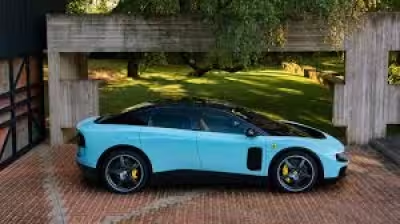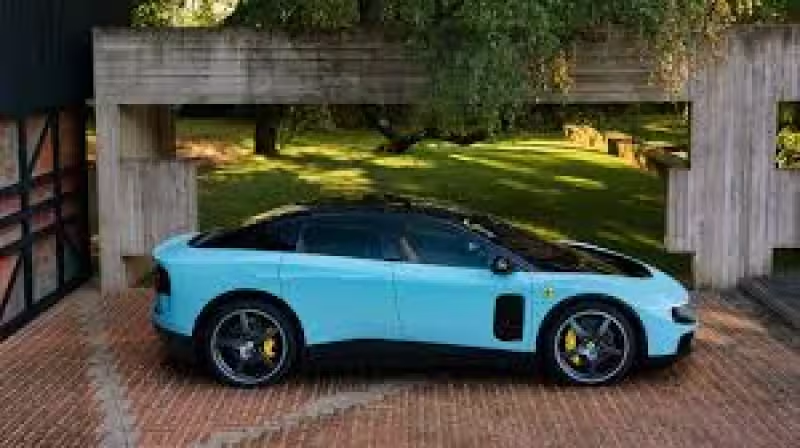
Ferrari took the wraps off the Luce, its first electric car, a battery‑powered production model the company says will arrive in 2027; the design role fell to LoveFrom, led by Jony Ive and Marc Newson.
The Luce is a numbers statement: four synchronous permanent‑magnet motors producing a combined 1,035 horsepower, front motors rated at 282 horsepower and rear motors at 831 horsepower. Ferrari says the car will hit 62 mph in 2.5 seconds, reach 124 mph in 6.8 seconds and top out at 193 mph. The company calls the Luce the most powerful roadgoing Ferrari it has made and says its 1,035‑horsepower output exceeds that of any prior roadgoing model.
More than performance, the Luce rewrites Ferrari geometry. It measures 197.9 inches long—two inches longer than the Purosangue—and stands 60.8 inches high, about two inches lower than the Purosangue. Ferrari used a dedicated EV architecture to shape the body and cabin, and the result is a five‑seat layout Ferrari says is a first for the brand, plus the largest trunk ever fitted to a Ferrari. The company also says the Luce has a drag coefficient lower than any prior roadgoing Ferrari.
The car’s doors and rear access underline the break with tradition: center‑opening doors and a liftgate, headlights and taillights that illuminate from dark panels, and windshield wipers that park upright against the A‑pillars. Inside, Ferrari mixes digital and mechanical cues. OLED displays fill the cabin; the instrument cluster uses three metal‑ringed dials that are actually digital screens. The center dial shows speed and battery charge, the left dial shows available power and regen level, and the right dial is configurable. That gauge display moves with the steering column.

Ferrari kept tactile controls where it matters: the steering wheel uses real switchgear instead of the touchpads seen on the Purosangue and includes two manettino dials, while two large paddles flanking the wheel control regen and maximum torque output. The central touchscreen incorporates physical switches, can pivot toward either front occupant, and a rear screen is mounted at the back of the center console for passengers in the back seats.
The Luce’s hardware echoes its ambition. Four motors provide all‑wheel drive and the company says the car weighs nearly 5,000 pounds. To manage that mass and unleash straight‑line performance, Ferrari built a launch mode activated by a pull handle in the overhead console; Ferrari says engaging it optimizes traction control, provides an extra torque boost and unlocks an additional 54 horsepower.
Among the newest electric cars, the Luce is framed by Ferrari as a major departure in both appearance and powertrain. The company described it as its most controversial model ever, and the switch to a dedicated EV architecture shows how the constraints of electric propulsion have shaped everything from proportions to interior layout.
The tension is obvious: Ferrari claims class‑leading aerodynamics and supercar acceleration while also delivering a five‑seat interior, the largest trunk in brand history and a curb weight that approaches 5,000 pounds. The Luce piles on technology and power to offset the penalties of mass, but the balance between Ferrari’s traditional agility and the compromises of EV packaging is the fault line the car exposes.
Ferrari’s gamble is now set for 2027 delivery. The company has built an electric car that discards several long‑held rules—single‑minded lightness, compact two‑seat arrangements and strictly combustion propulsion—in favor of broad utility and blistering output. The real test is whether buyers will accept a nearly 5,000‑pound, five‑seat Ferrari as the future of the marque.